
Frau Holle’s Werkhaus is included in the 2025 Electronic Literature Organization international media arts festival “ELO25 @ 25: Love Letters to the Past and Future” from July 10-13, 2025 at York University in Toronto Canada. Frau Holle’s Werkhaus was originally tested and exhibited in the group show Catching Up / Resurfacing at Joseph Nease Gallery April 22 – June 17, 2023. The project was later exhibited in the University of Minnesota Duluth faculty exhibit at the Tweed Museum of Art, October 2023 to February 2024.
Credits
Video credits: Linnéa Hinkel plays the roles of the two daughters. Joellyn Rock as the silhouette of Mother Holle. Puppeteering by Jamie Harvie, Cathy Podeszwa, and Rob Wittig. Grandmother voice by Leonore Baeumler. Silhouettes for Frau Holle’s Werkhaus were created in the Motion and Media Across Disciplines Lab at University of Minnesota Duluth. Music licensed via Music Vine: Fairy Tale Waltz by Giulio Fazio, Clockshop Closing Hours by Leon Riskin, Snowflakes by Blut Own, Pulse by Yoel.
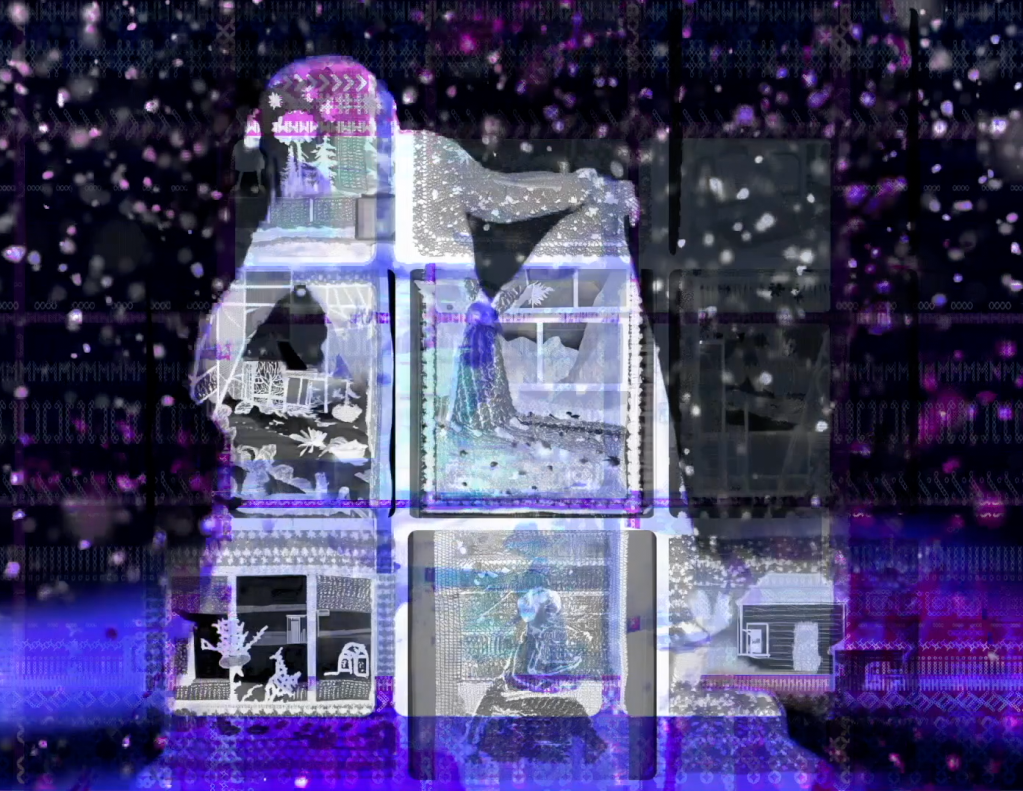
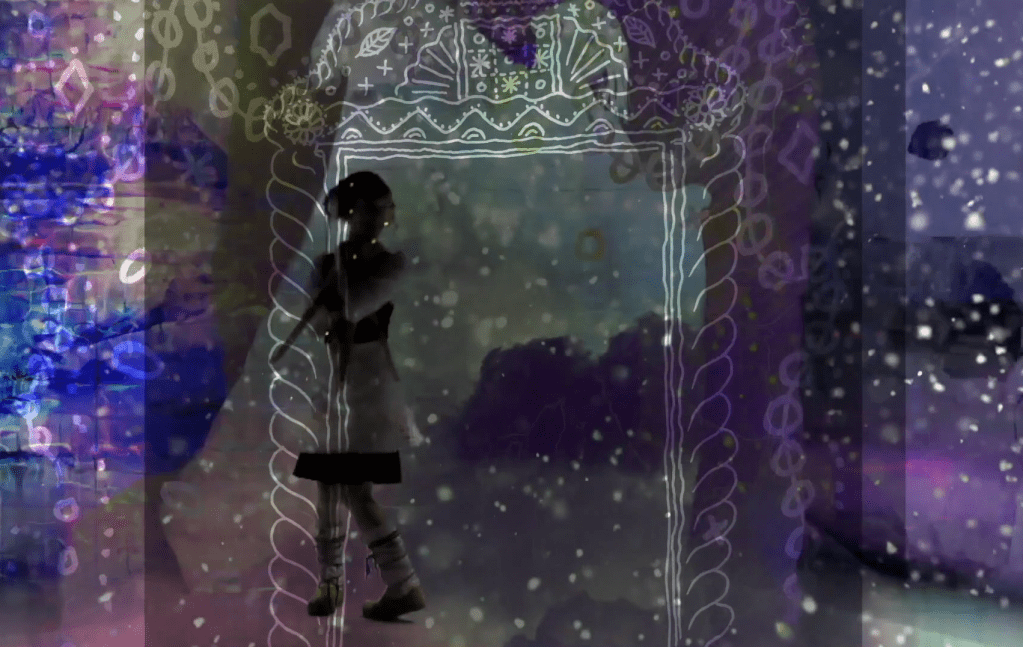
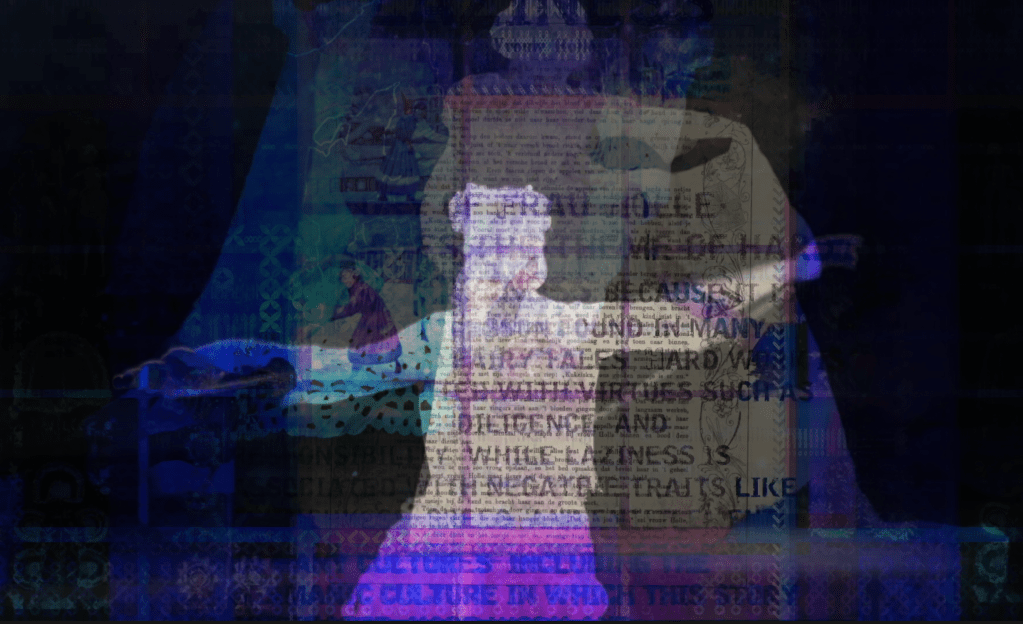
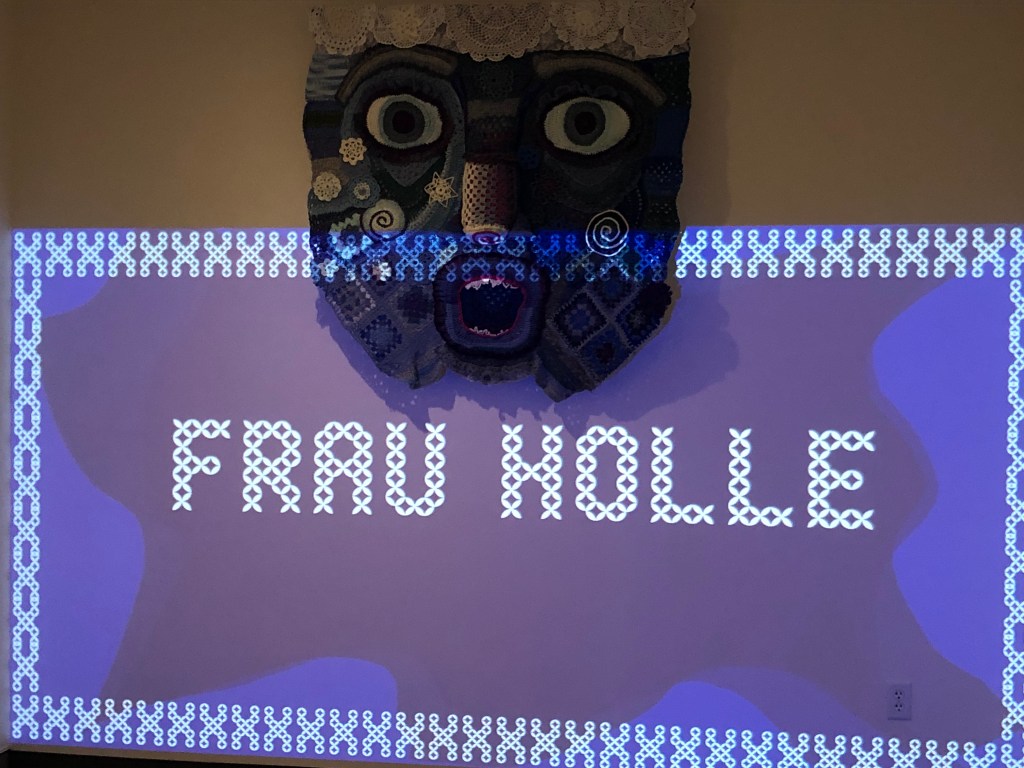
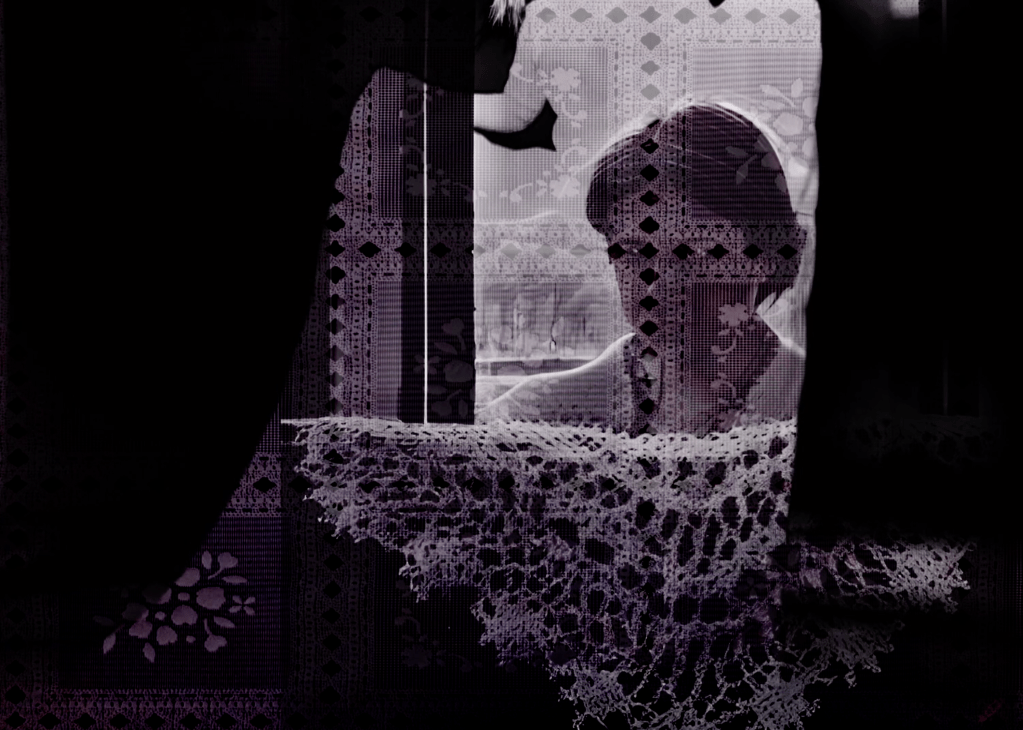
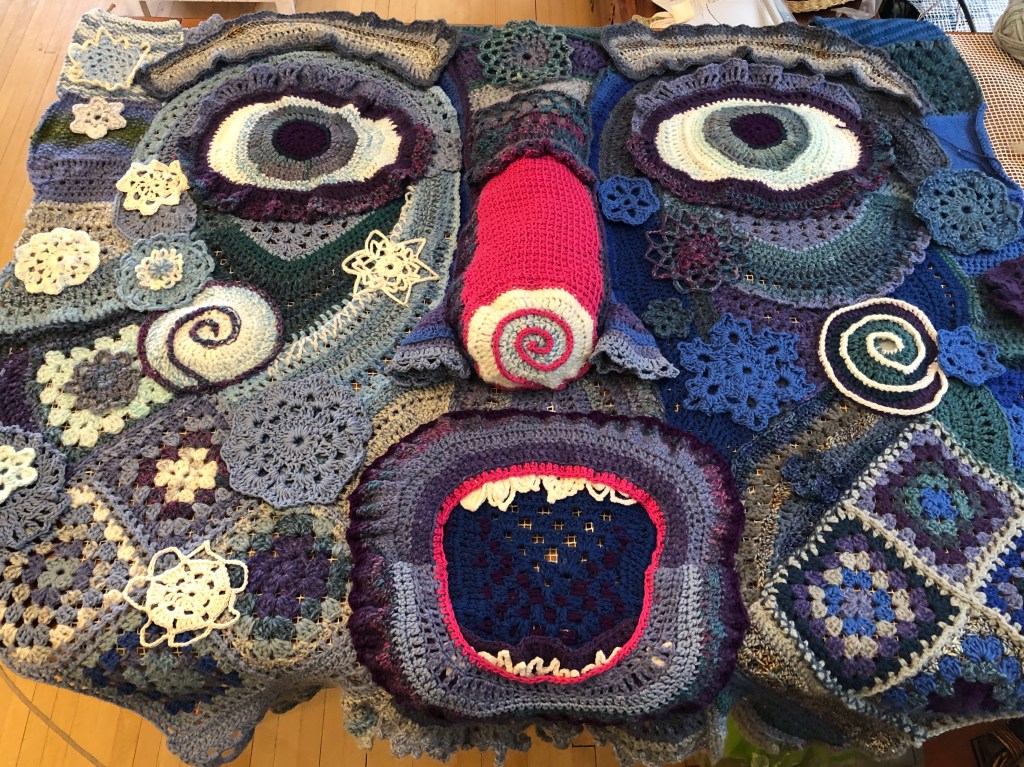
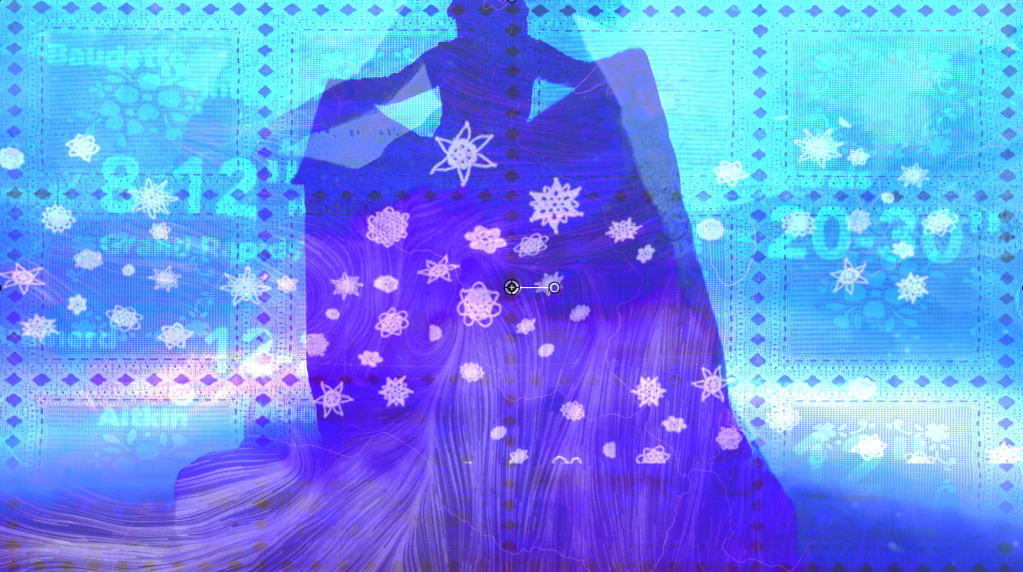
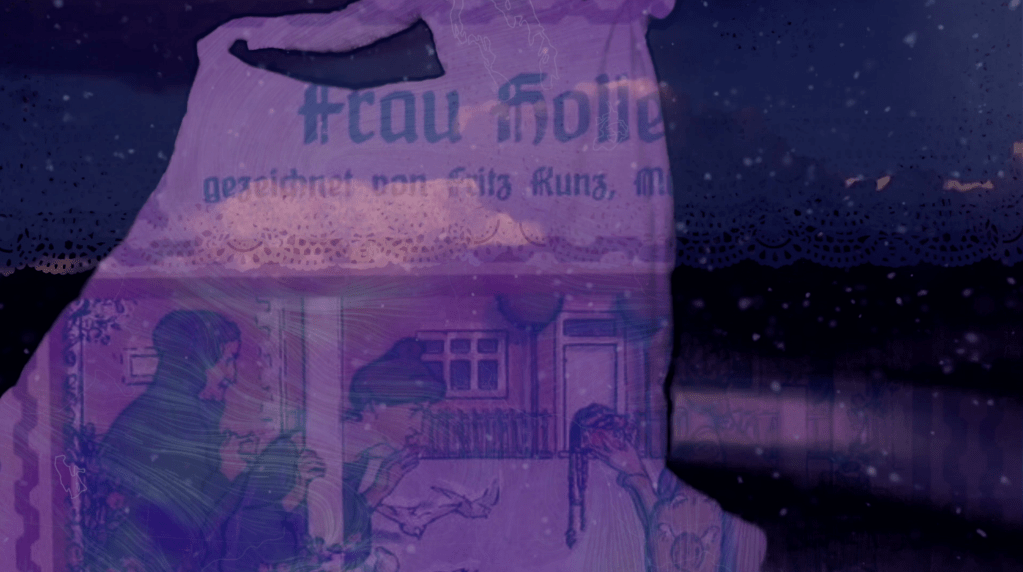
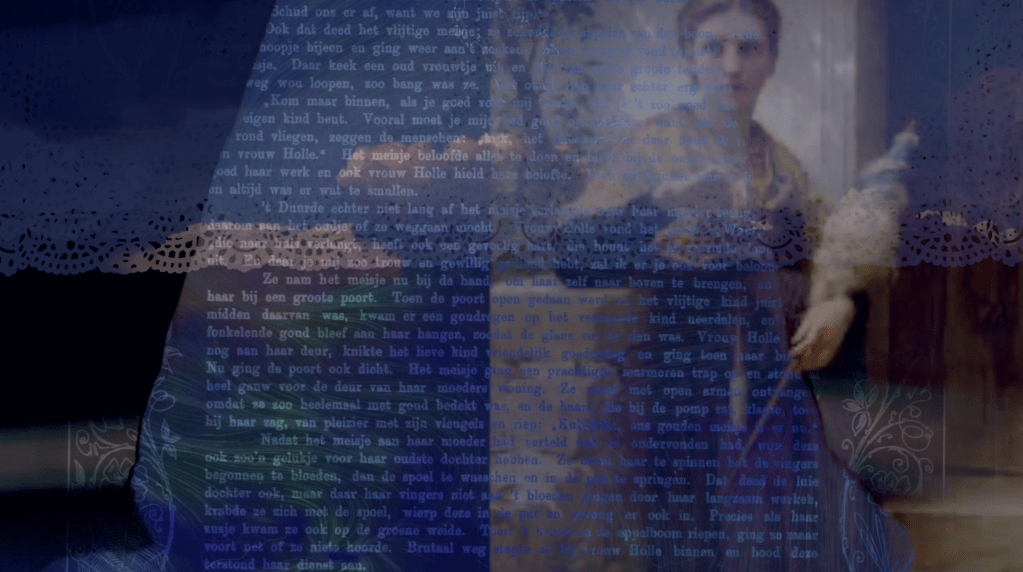
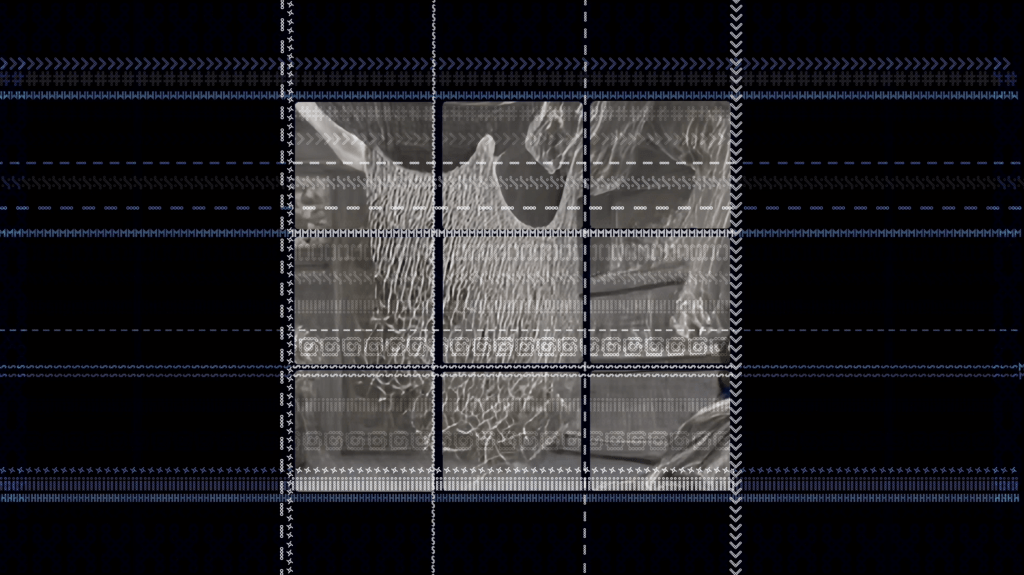
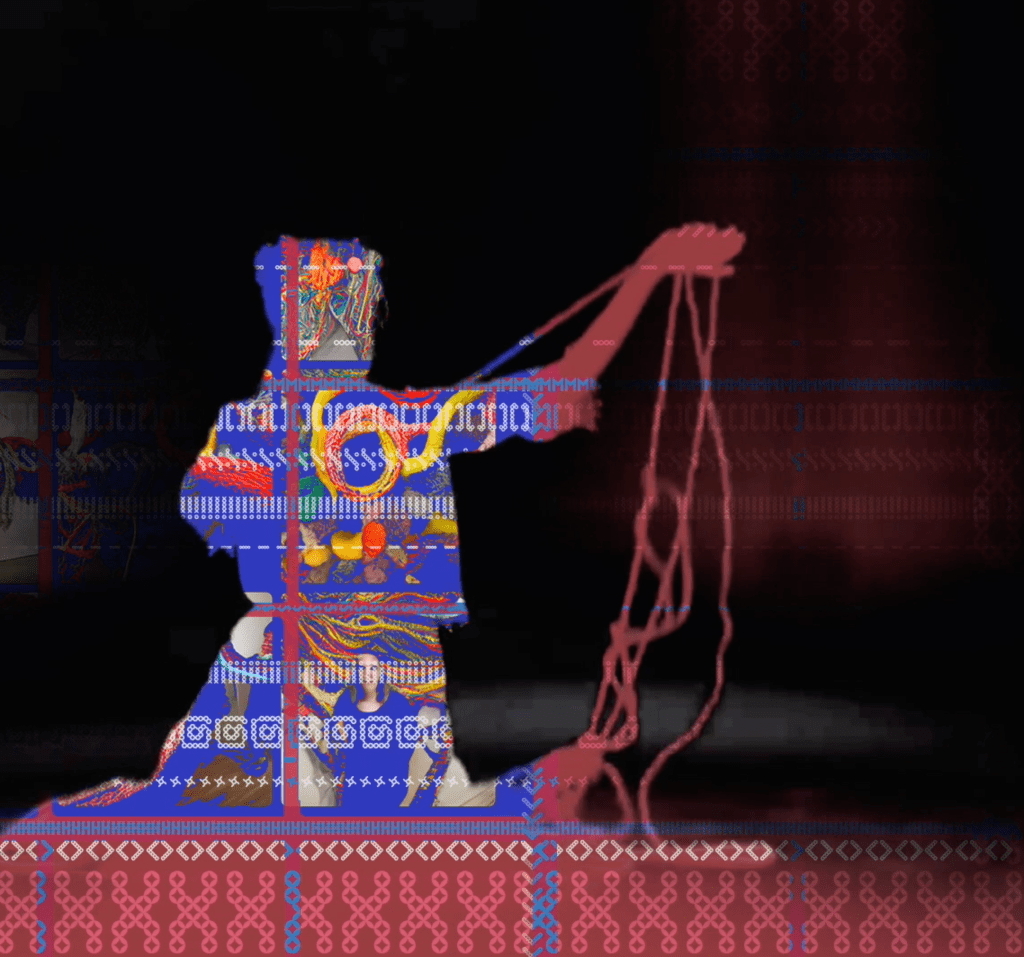
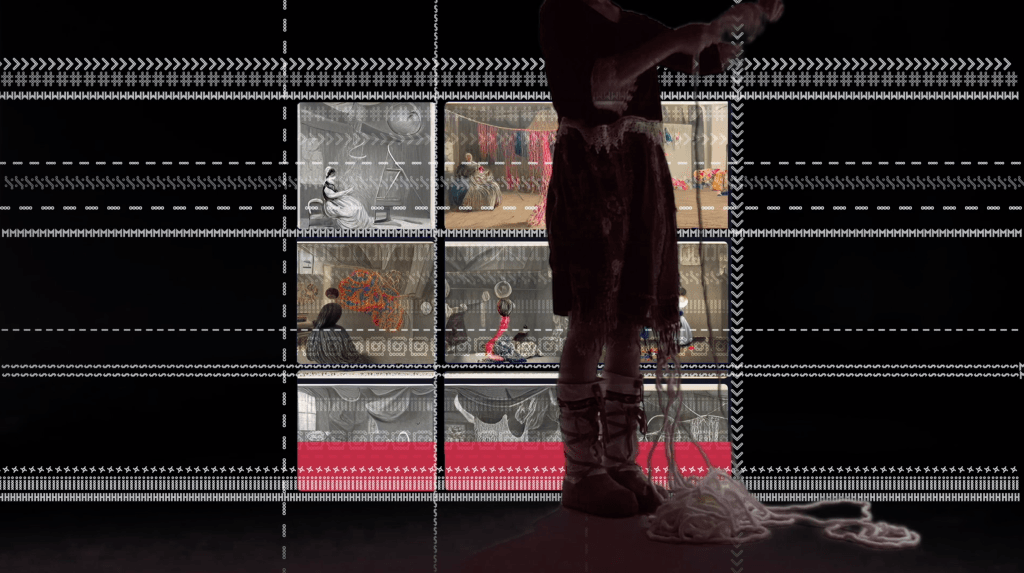
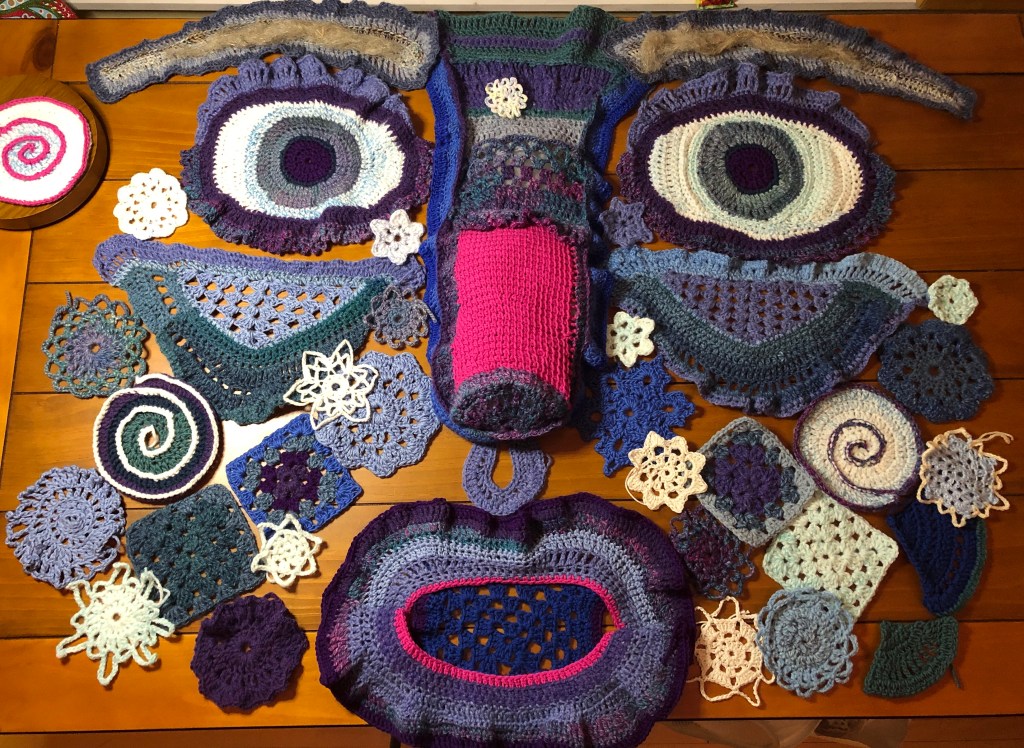
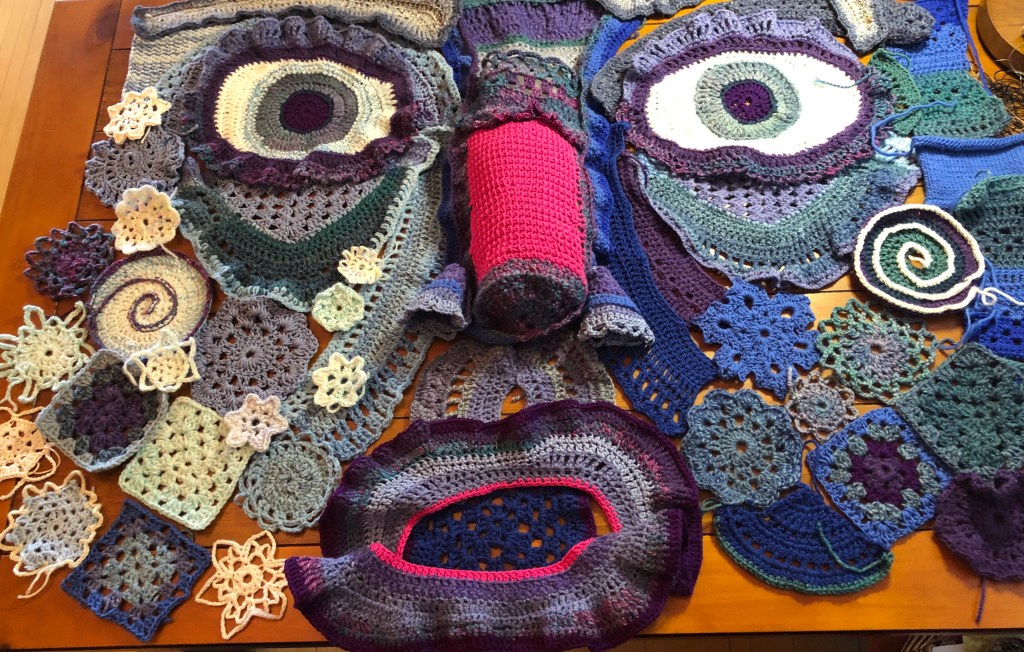
Frau Holle’s Werkhaus is a mixed-media installation, combining experimental video projections and large scale hand-crafted crochet. The project re-spins the German fairy tale about climate mistress Mother Holle and the two girls who must shake her feather bed to make it snow. Visual media includes multi-layered video vignettes, a mix of texture gathered from climate data, fiber art patterns, historical public domain images, experimentally generated imagery, and original digital art. Audio includes voices reading from fragments of Joellyn Rock’s retelling of the fairy tale, her Frau Holle “scrumble” essay, and multiple versions of the story generated via human and AI creative writing experiments. The legendary figure of Frau Holle oversees the fiberwork of women and girls, supervising their spinning and weaving. Frau Holle’s Werkhaus toys with threads of this old tale, questioning the value of women’s work, artificial intelligence, climate change, and moral fiber. The mixed-media fiber art / digital installation features a large crochet puppet of Frau Holle with projected text and video.


ESSAY: a scrumble of thoughts about mixing fiber arts with A.I. and experimental video…
Telling old tales in new ways has long been my thing. I’m fascinated by how emerging media can change the way we retell a story. Interactive, multimodal, multimedia… so many ways to spin a tale. For me, it is the multivalence of the fairy tale form that makes it a rich playground for experimental storytelling. A folk tale in the public domain… I am free to shake my own messy ideas from it!
The German fairy tale of Frau Holle is passed down to literature and multimedia from the oral tradition. One version told to the Brothers Grimm by Dortchen Wild appeared in the first edition of Kinder und Hausmärchen in 1812. Variations of the tale have been translated to English over the years. Finally returning to the original Grimm, it was translated by Jack Zipes in 2014’s The Original Folk and Fairy Tales of the Brothers Grimm: The Complete First Edition.
In the story, a widow has two daughters, one beautiful and diligent, the other ugly and lazy. The hard-working girl spends all day spinning thread, while the other one slacks off. When the industrious daughter jumps into a well to retrieve her lost spindle, she re-emerges in the enchanted world of Frau Holle. There she performs a series of helpful domestic tasks. Everyday she shakes out the bedding of Frau Holle to make the feathers fall as snow over the landscape. The obedient girl is rewarded for her dutiful work with gold and jewels. The lazy daughter follows in her footsteps, but does a poor job of each task and is punished in the end.
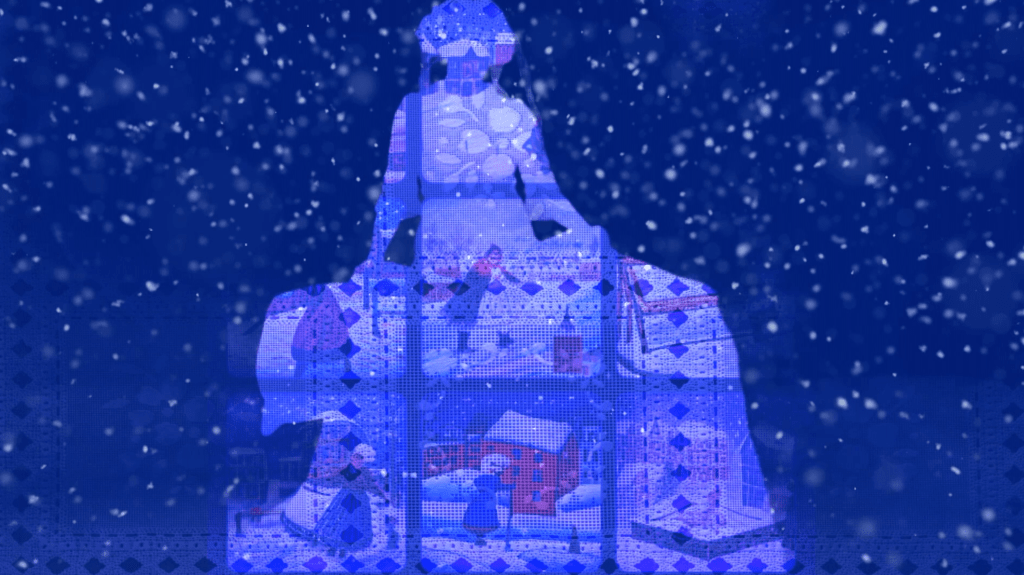
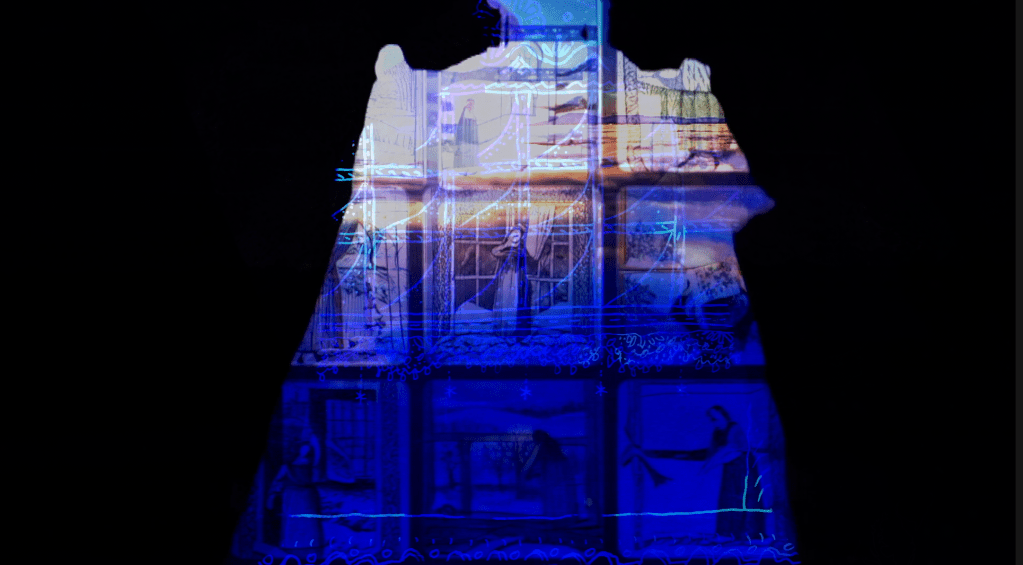
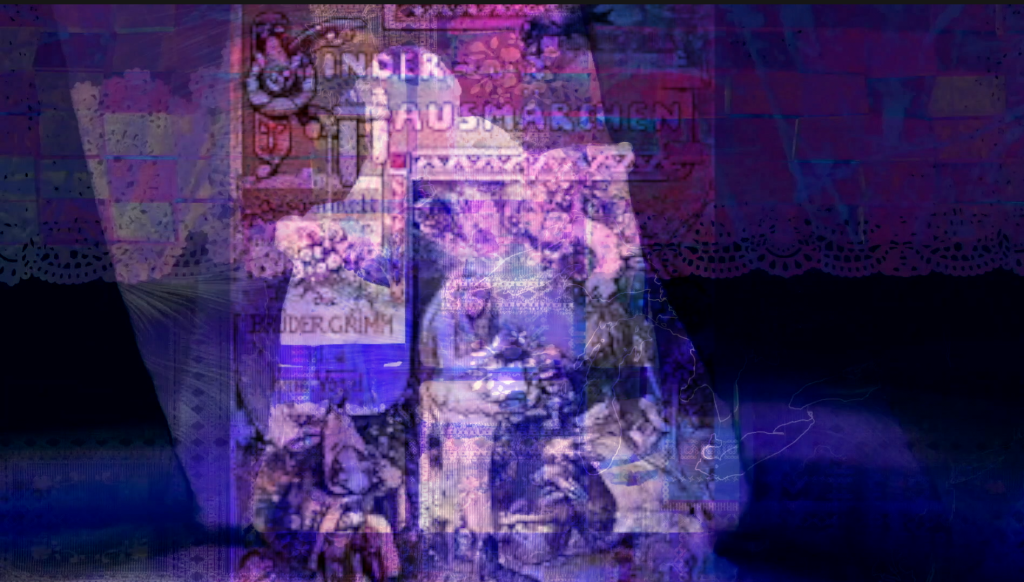
I am drawn to the theme of snow, the idea of climate control animated by Frau Holle’s feather bed.
I am drawn to the rhythmic structure, imagining the tale told while women do their spinning.
I am drawn to (and repelled by) the contrast between the industrious girl and the lazy girl, the intertwined history of both female worth and textile technology.
Fans of the Bechdel Test will note that this story doesn’t have any male characters at all! The first words say it all: “A widow has two daughters”. And girls without a male provider are reliant on their own handiwork and determination to survive.
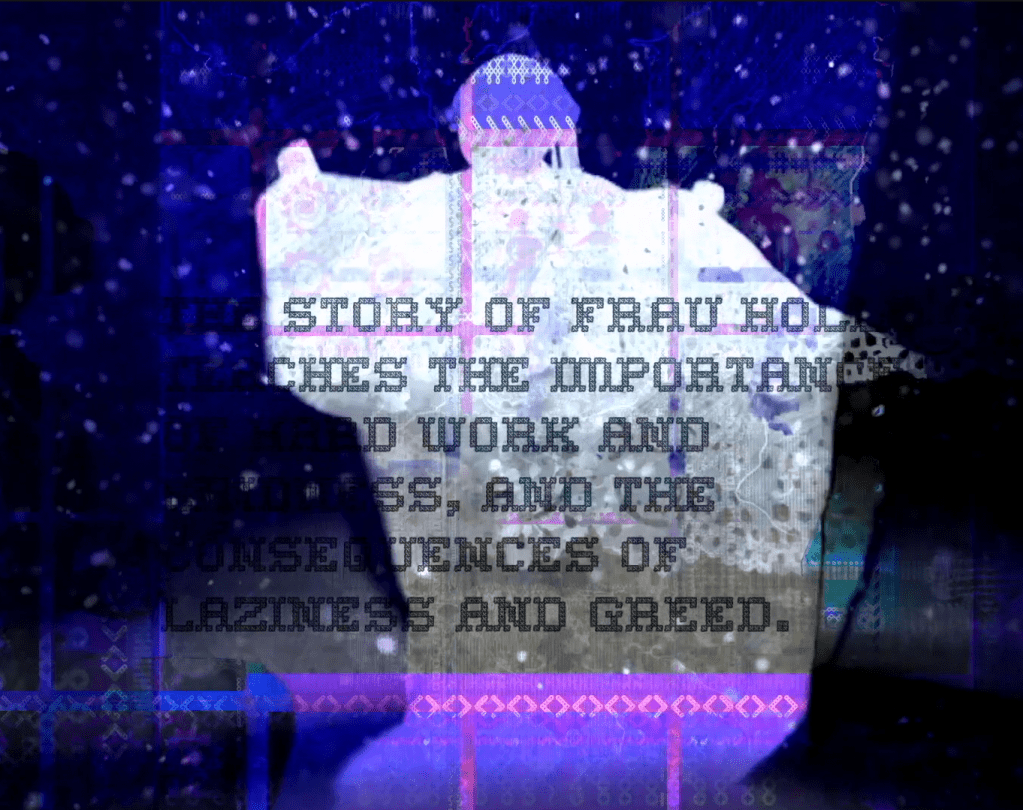
The legendary figure of Frau Holle (known in different regions as Holle, Holda, Perchta, Berchta, Berta, or Bertha) was probably a pre-Christian female deity. Mother Holle oversees the fiberwork of women and girls, supervising their spinning and weaving. She is also a climate mistress. When she shakes her feather bed, it snows! Holle’s festival is midwinter, possibly during the Zwölften, or12 days of Christmas. In her dual nature, she can be both fearsome and benevolent, sometimes called the Dunkle Großmutter (Dark Grandmother) or the Weisse Frau (White Lady.) One regional incarnation, the Spillaholle (“Spindle” Holle), is particularly frightening, a raggedy hag who threatens to beat children with stinging nettles if they have not finished their spinning on time.
In the morality drenched landscape of German fairy tale stories, qualities of character are clearly defined: good vs bad, industrious vs lazy, perfect vs imperfect. Hard work is rewarded and laziness is punished. Useful points to drive home to the girl textile worker whose thread spinning provides a living for a widow’s household.
I caution the listener not to be too put off by the use of simple dichotomies… Ugly vs Pretty? Shoulders shrug, heads shake. The fairy tale is a place for voices to dialog, a listener at the knee of the storyteller, the tale gets interrupted, the yarn frogged and reworked.
I am thinking of other spinning tales… and other ways to spin a tale.
YARN
After two decades of experimenting with layers of digital media, I craved the texture of materials. I wanted to work with my hands again. I had inherited some bags of old yarn, knitting needles and crochet hooks, passed down to me from mom and grandma and other unknown generations. I unscrewed the lid on a metal cigar container. Inside I found a collection of crochet hooks, some very thin, made from ivory or bone…whose were these and what delicate thing did they make with them? And who was this unfinished blue baby thing on needles for… some boy now grown? Then I awkwardly remembered a chunky 60s era crochet vest made by Grandma for her granddaughter. Harvest gold yarn, a very popular color that year. She must have taught me a little crochet, but I had no skill memory left. And that vest was long gone.
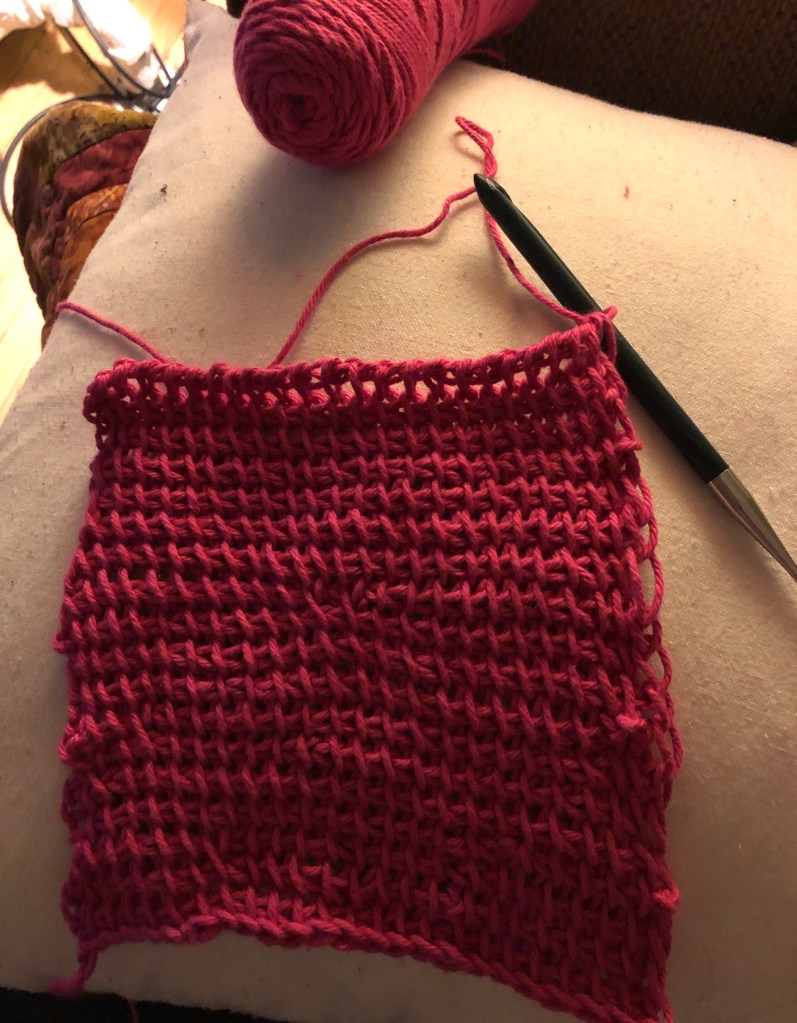


I went down the rabbit hole of fiber and textile history research… Falling asleep at night listening to audio books: The Golden Thread – How Fabric Changed History, The Fabric of Civilization – How Textiles Made the World, Women’s Work – The First Twenty-Thousand Years – Women, Cloth, and Society in the Early Times, Fabric – The Hidden History of the Material World. It seemed that women had been spinning and making things out fiber for a really really long time. It has always been our work.
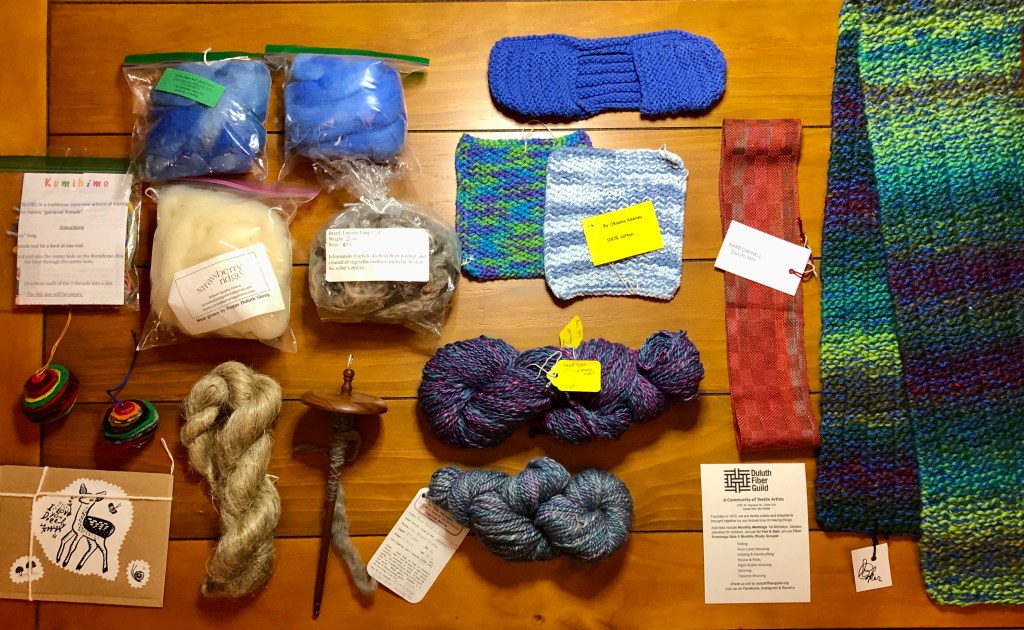

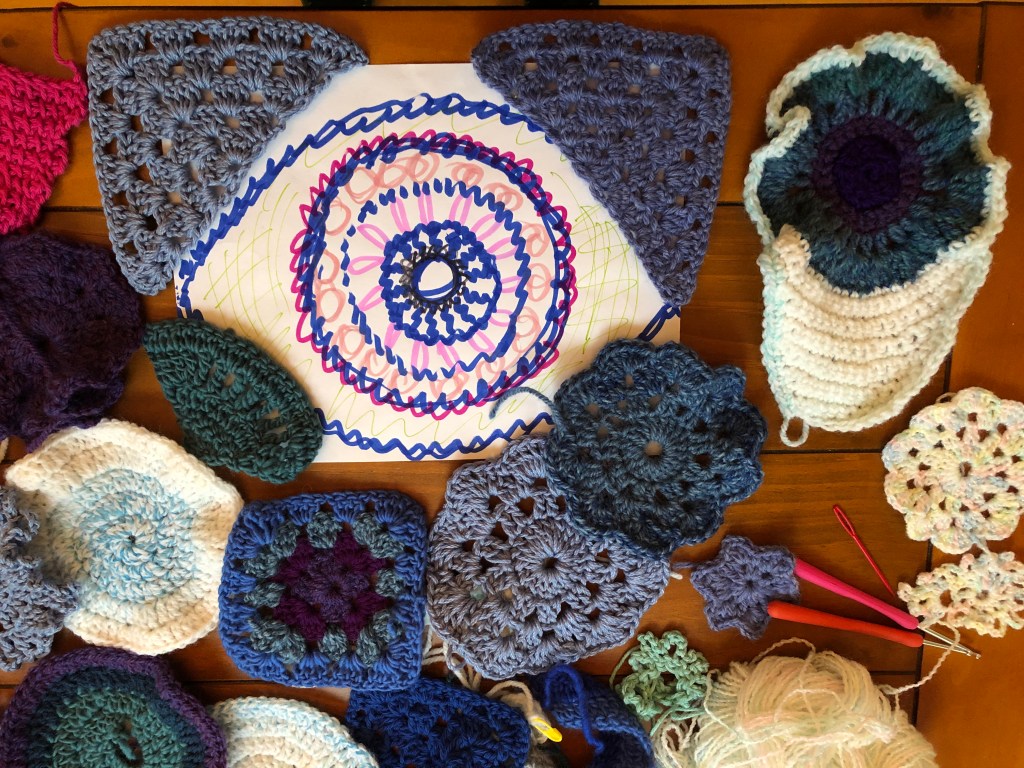
I started buying yarn and signed up for a beginner crochet classes at Yarn Harbor. (Thank you Brenna!) I found generous help in fiber enthusiasts. At a Duluth Fiber Guild gathering, I touched flax and tow, and began to learn how to use a hand-spindle to spin wool. (Thank you Louise!). I begged my friend to come over and teach me how to hold the crochet hook.(Thank you Cathy!) I binged YouTube tutorials from all over the world. Accents I couldn’t place. Foreign tongues with subtitles. I watched skillful hands demo how to crochet snowflakes and granny squares and odd textile crafts I’d never seen before. I was entranced by the textures of these diverse hands, old craggly hands with worn out nails and chubby younger hands with fancy decorative polish. But my hands were as awkward and clumsy as an A.I.rendering of hands!
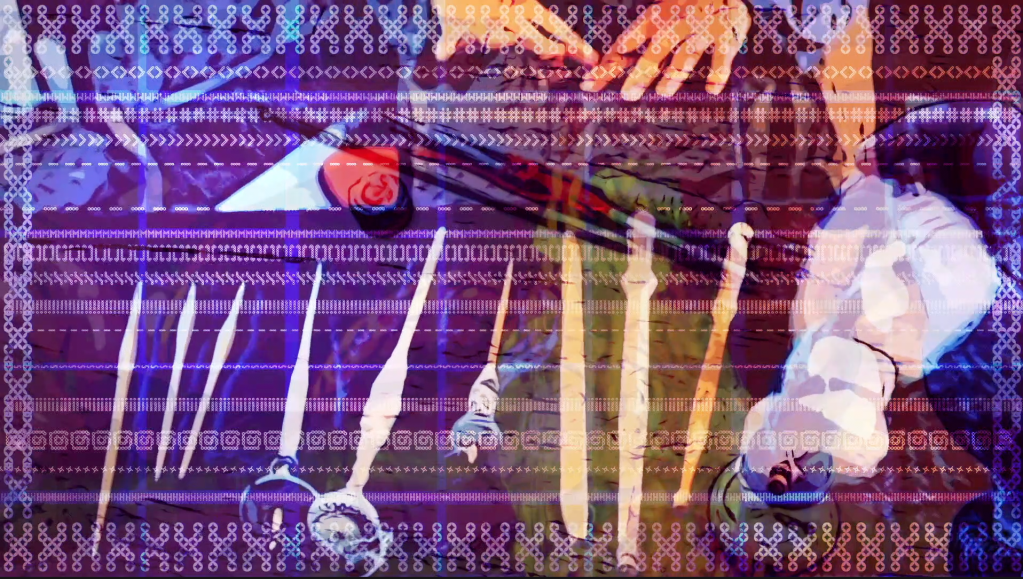

I strained to maintain the proper tension and slack between my fingers and the yarn and the crochet hook to complete a rudimentary row of stitches. All that counting and new terminology made me feel idiotic. When I looked at the other women shopping for yarn, I was humbled. They knew how to crochet! (They were all geniuses.) Note: Crochet is one of the only fibercrafts that is not machine made. If you purchase a crocheted item, it was most likely made by hand, by someone, somewhere in the world. The complexity of stitches and the process of working the hook back into the previous stitch makes it difficult to replicate by machine.
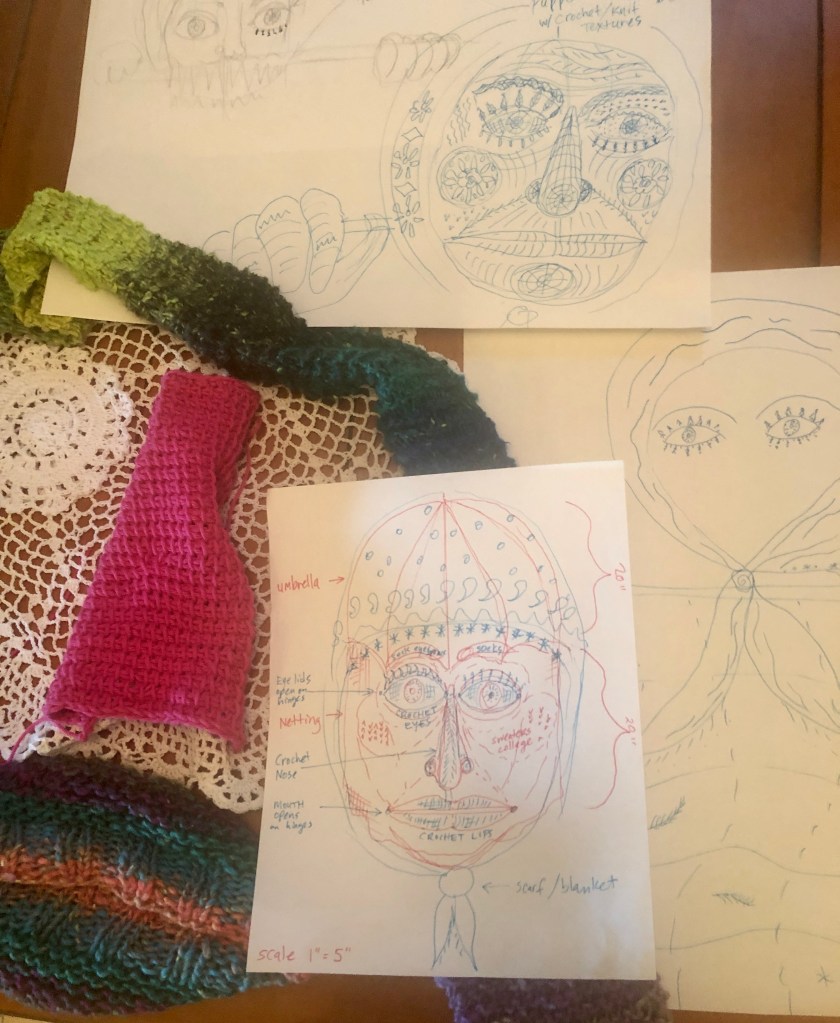
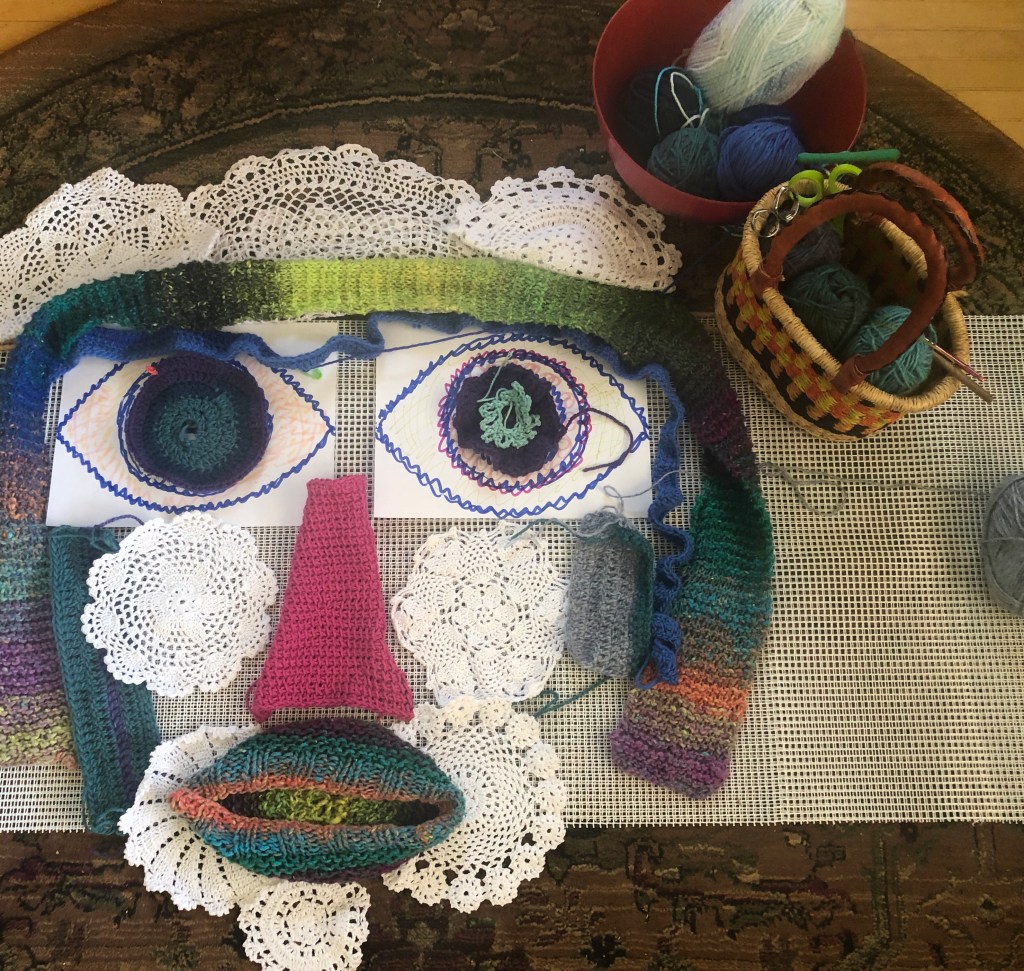
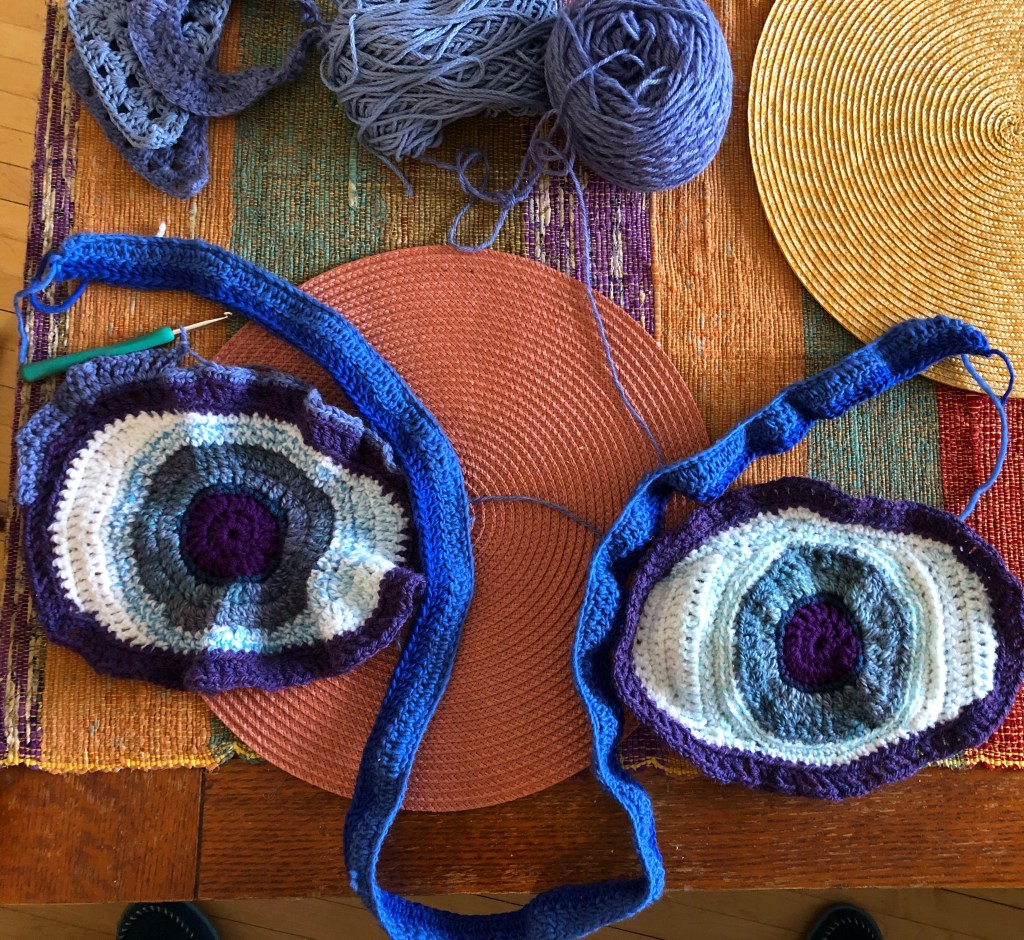
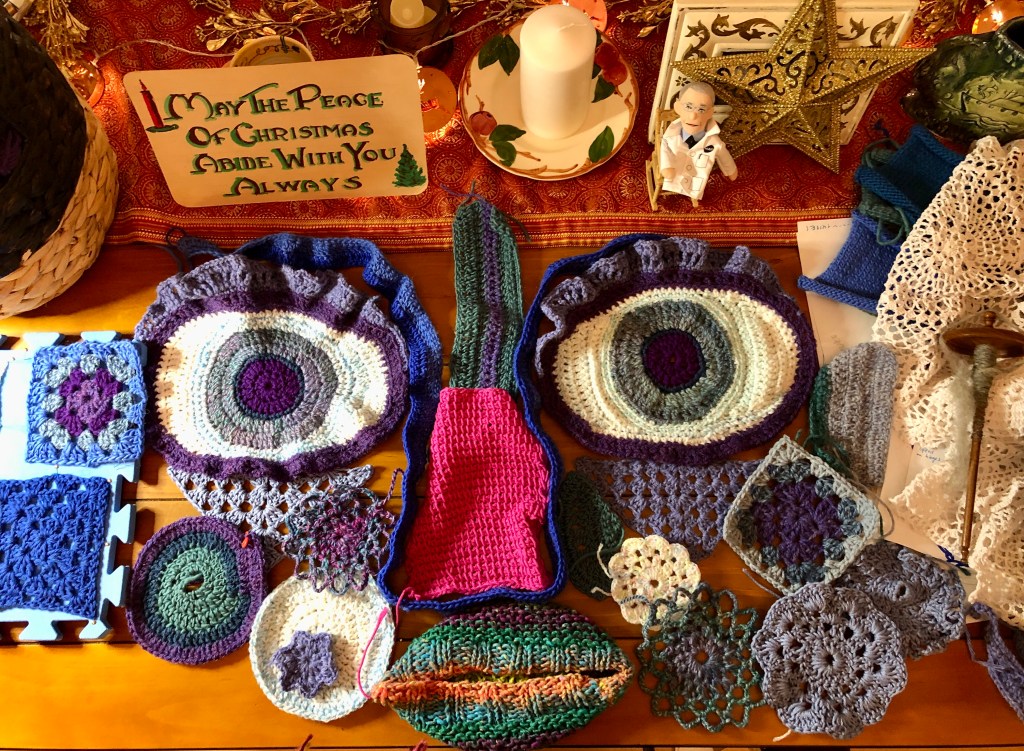
Very very slowly, I began to coordinate my fingers and the hook and the yarn. Eventually, I did this well enough to generate some granny squares and snowflakes and freeform scrumbles of my own. I had it in my tiny head to make a giant head of Frau Holle. In my dreams, the huge puppet would have crazy dangling mixed-media hair and flowing robes and carry a blanket bedecked with crochet snowflakes and video projections. I imagined her joining a parade, maybe All Soul’s Night in Duluth, or another of our wintery city’s public processions. Frau Holle’s head and blanket are still evolving… stay tuned for her future appearances.
PATTERN / REPETITION / VARIATION
As an artist I’ve had the urge to generate decorative repetition from simple dots and dashes scribbled by hand to elaborate ornamental patterns crafted on my computer. In waves of revival, the prevalence of pattern in art and design reveals our delight in the intense visual experience of repeating motifs… stripes, polkadots, complex geometrics, extravagant florals, shapes and colors.

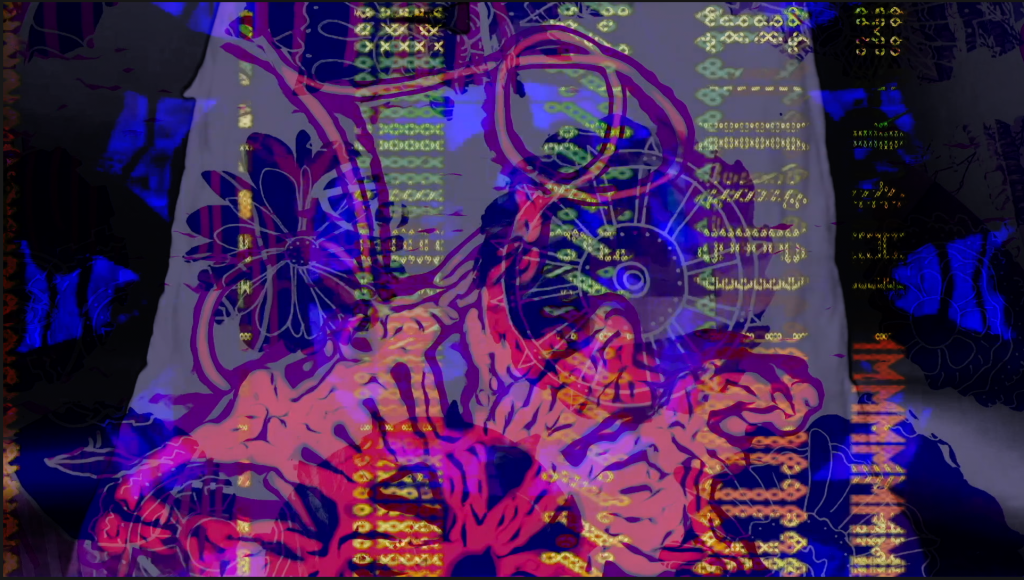
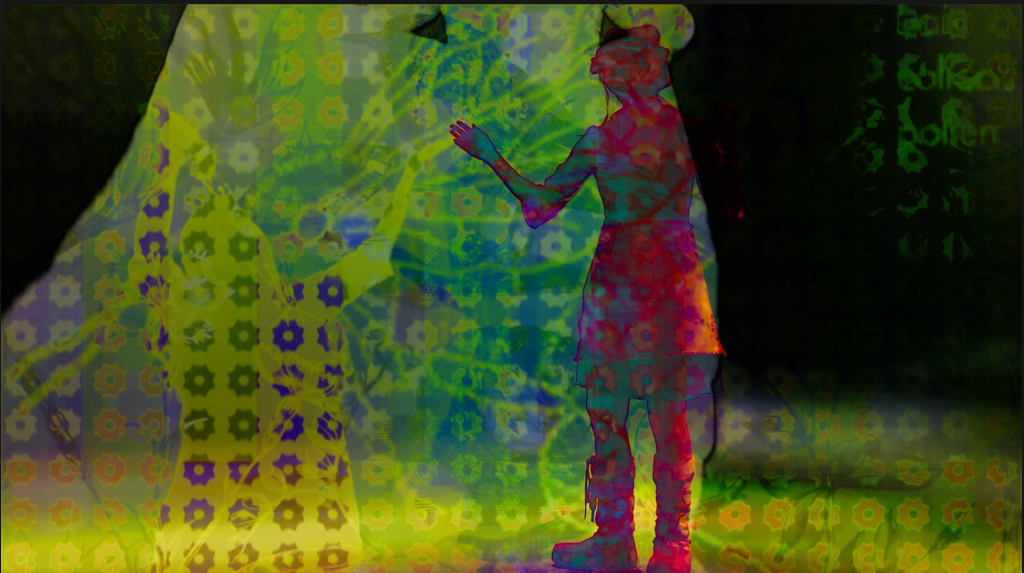
I’ve wondered if it is the tension between perfect pattern and imperfect pattern that constitutes beauty in nature… and in art?
My eye is drawn to repetition, the duplication of petals on a flower, leaves on a tree, trees repeating to infinity in the woods… Yet, within these patterns are aberrations, the little wrong ways those petals unfold, how the contour of those leaves differ, the branches on those trees forking awkwardly. It is this conflicting set of qualities… the perfect balanced with the imperfect, that seems so pleasing. It’s this tension that I like, in working with machine generated and handmade images. Not one without the other, but the mix.


LAZY vs HARDWORKING
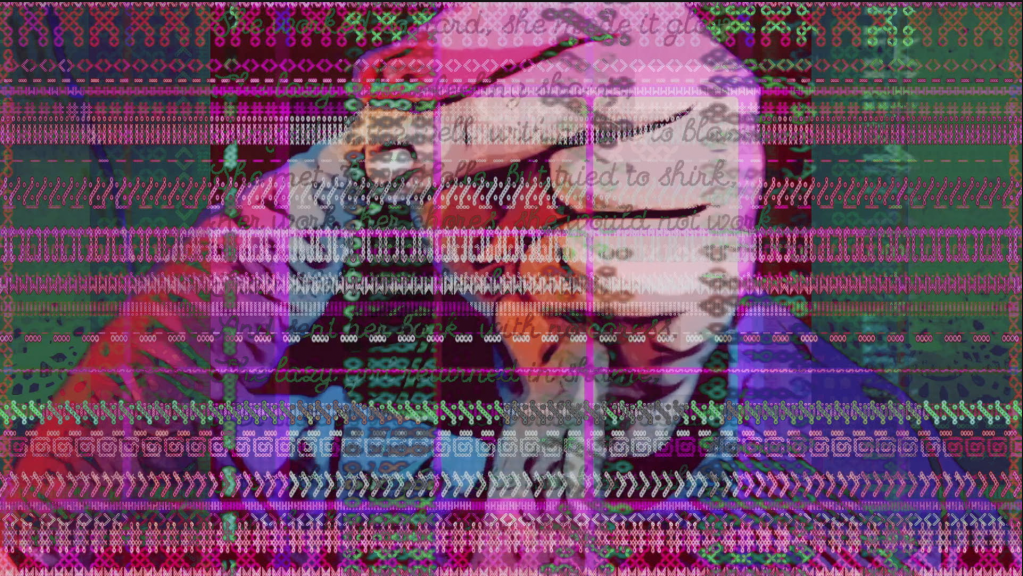
At the heart of the Frau Holle fairy tale is the especially harsh theme of the lazy daughter vs hard-working daughter. Over the past year, I’ve dabbled with Artificial Intelligence tools, A.I. image generation and A.I. text generation… and the results have been surprisingly awkward, sometimes banal, or hilarious, or horrifying. Far from perfect. I do love how A.I. faces are a surrealist mess, and those crazy hands that have too many fingers!? I dread the refinement of these tools, sure to come, when I will have to work even harder to disrupt their polished surface. For me, it’s the glitchy-ness of the artificial that reasserts the imperfect charm of folk art.
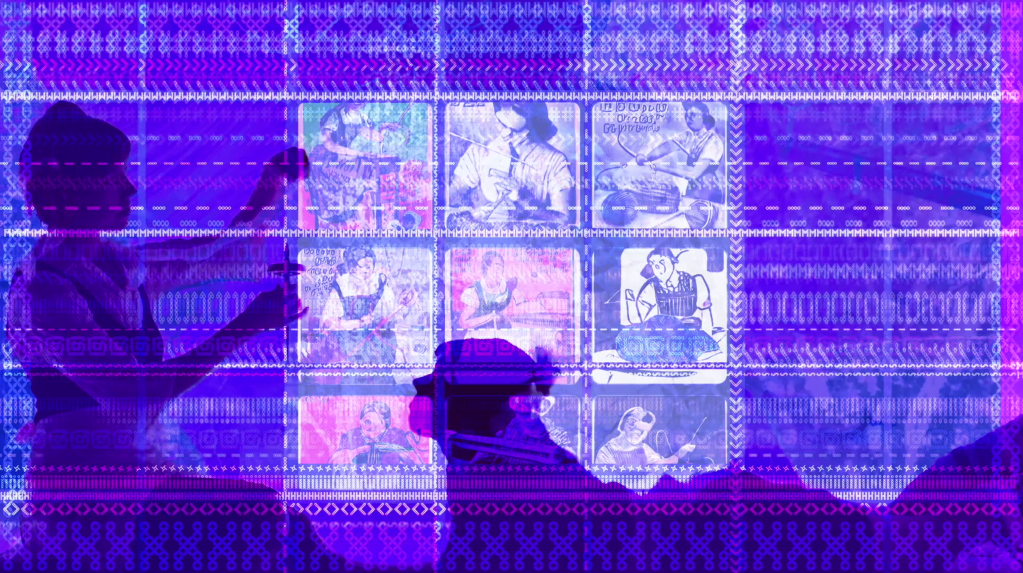
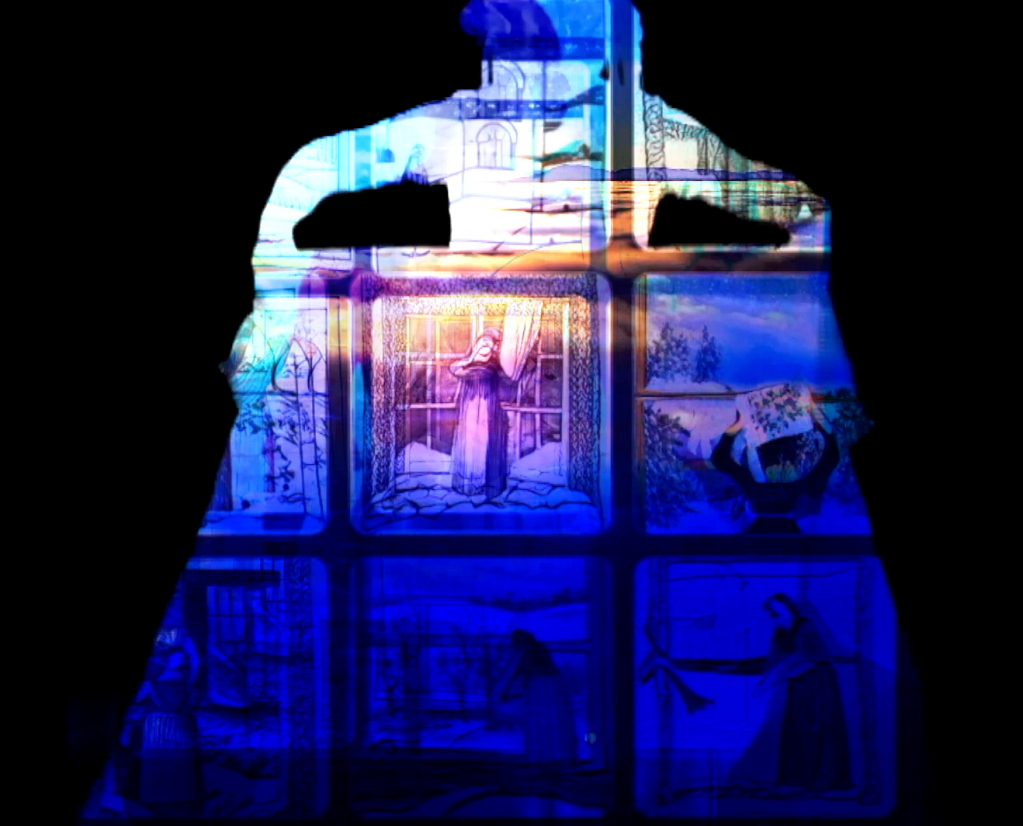
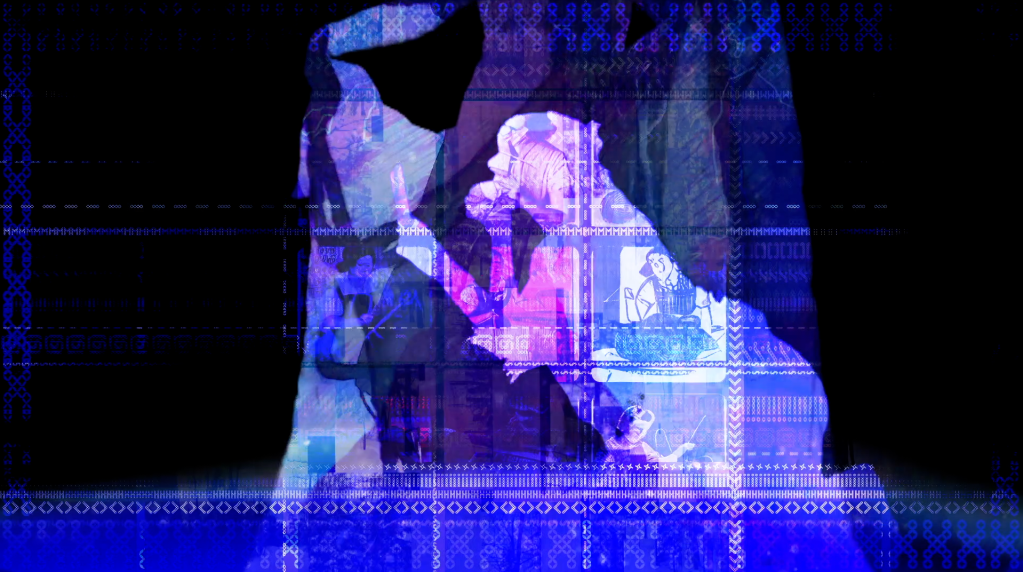
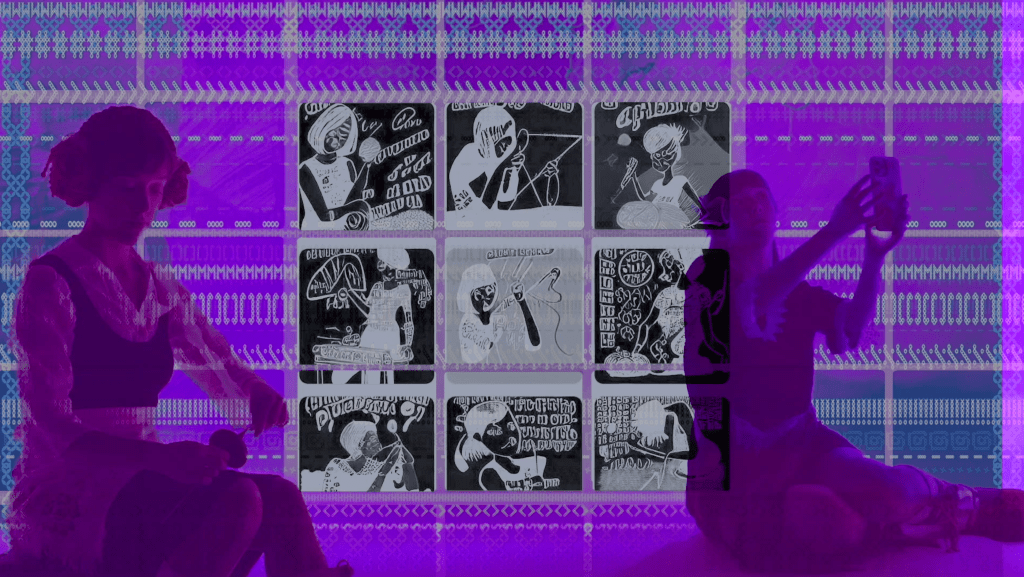
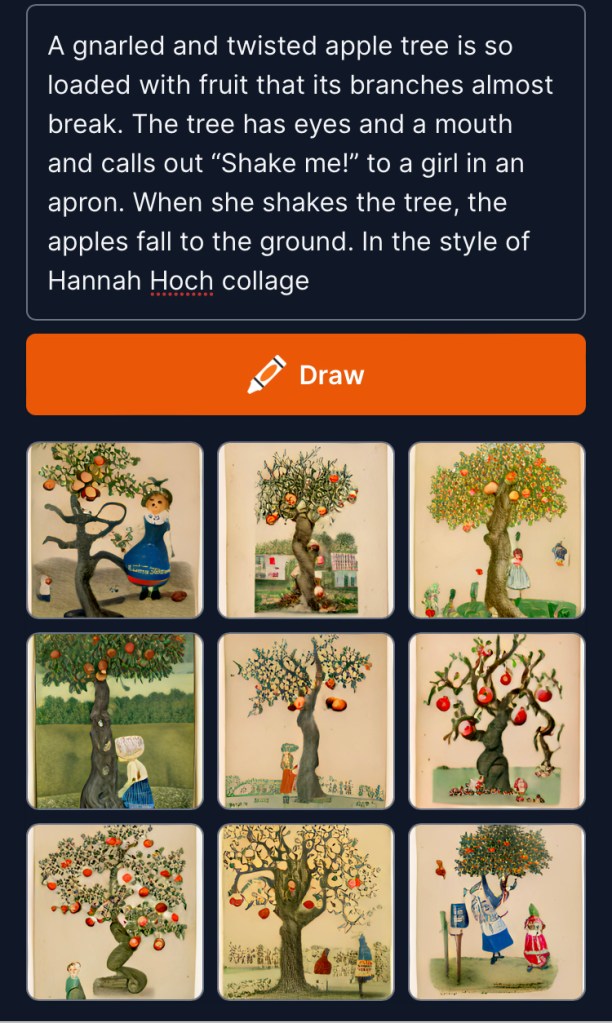
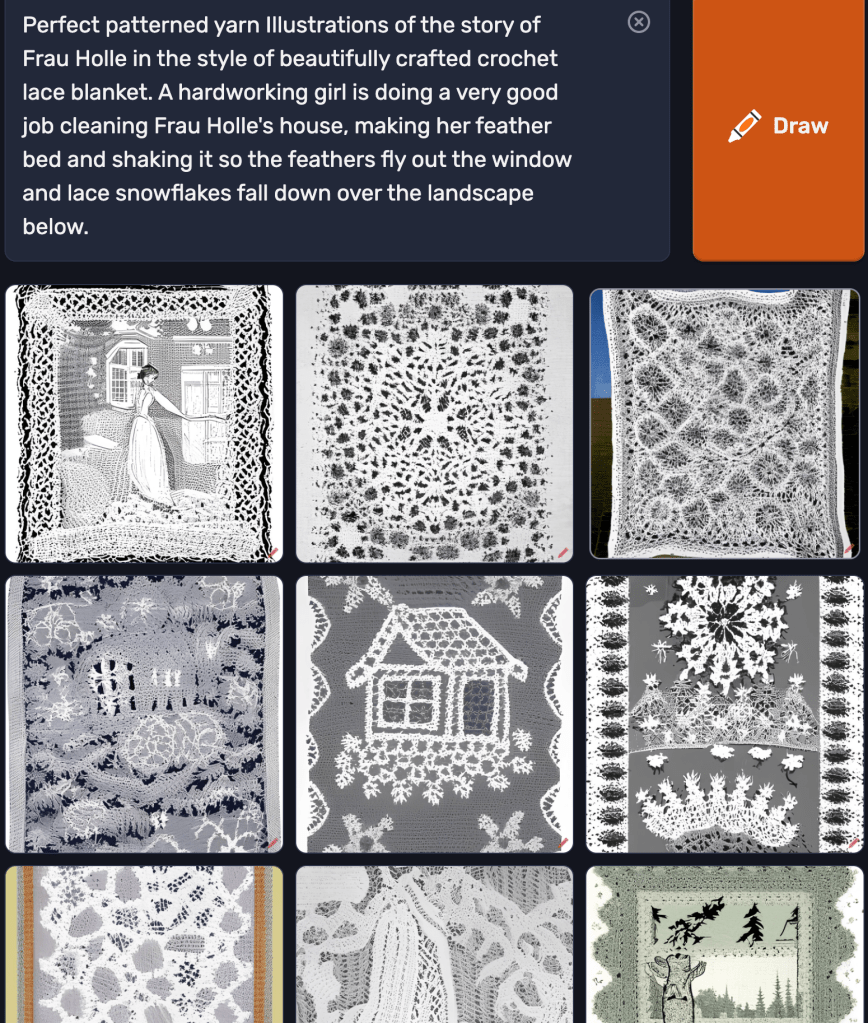
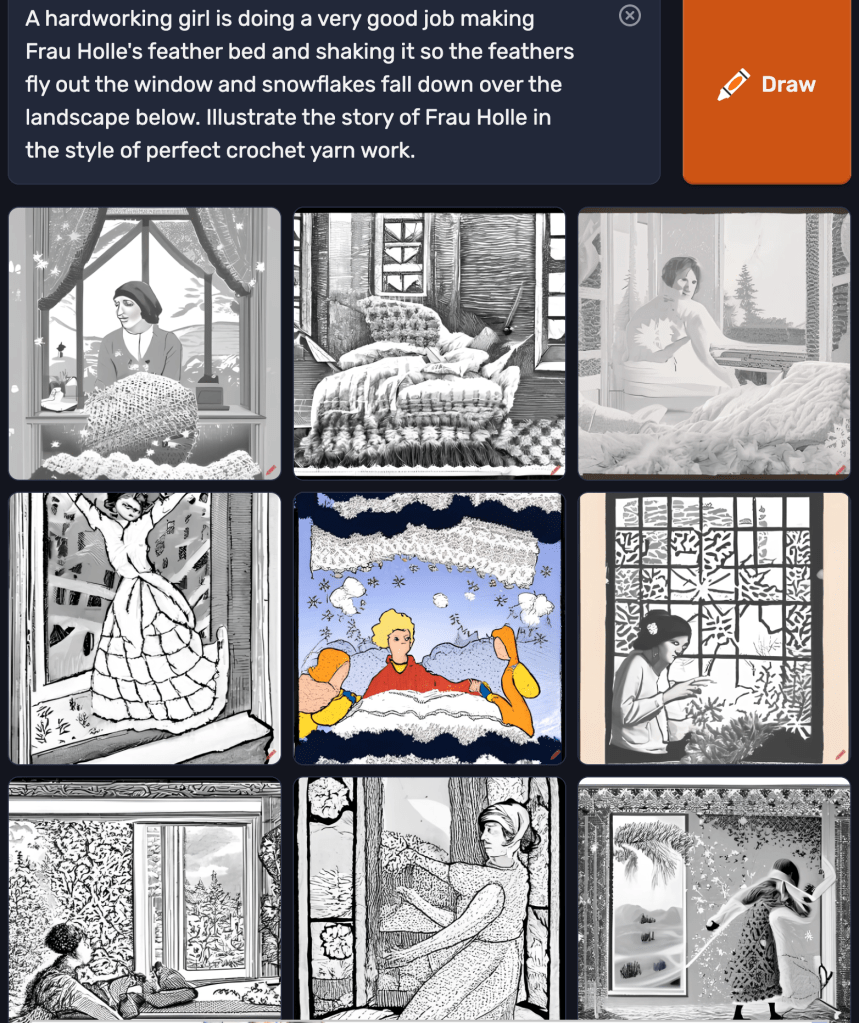
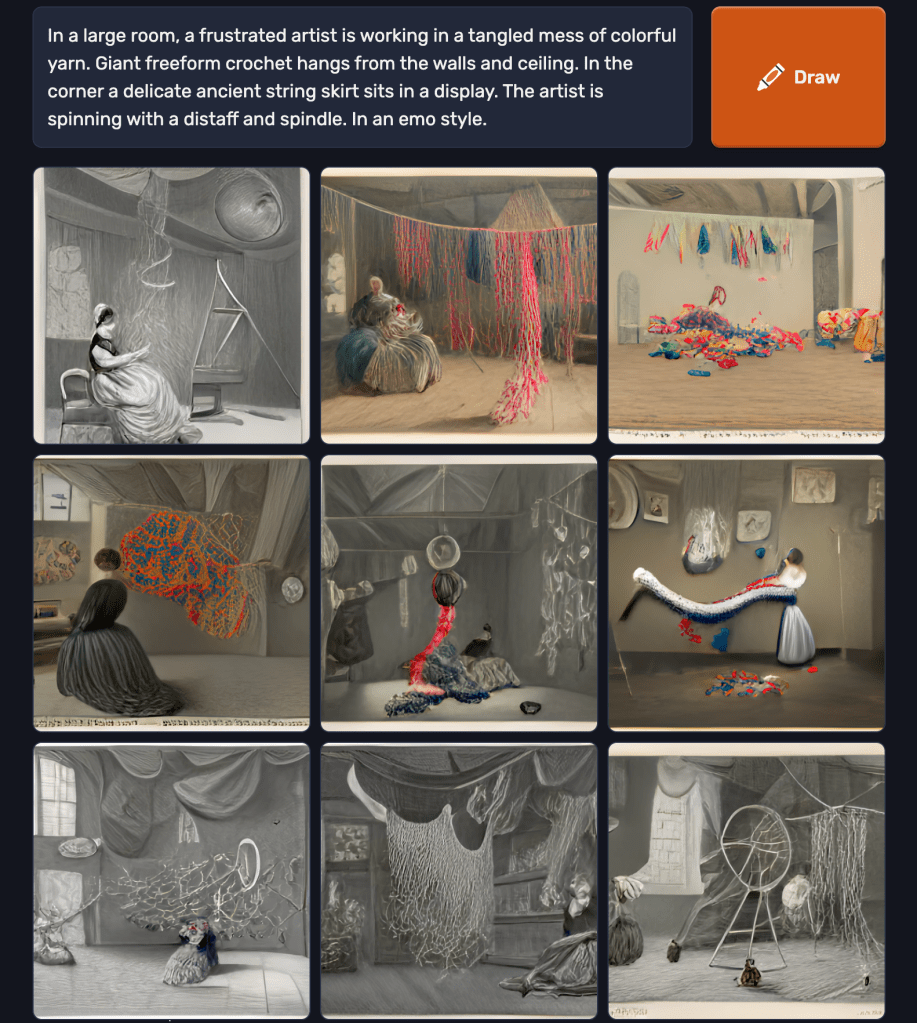
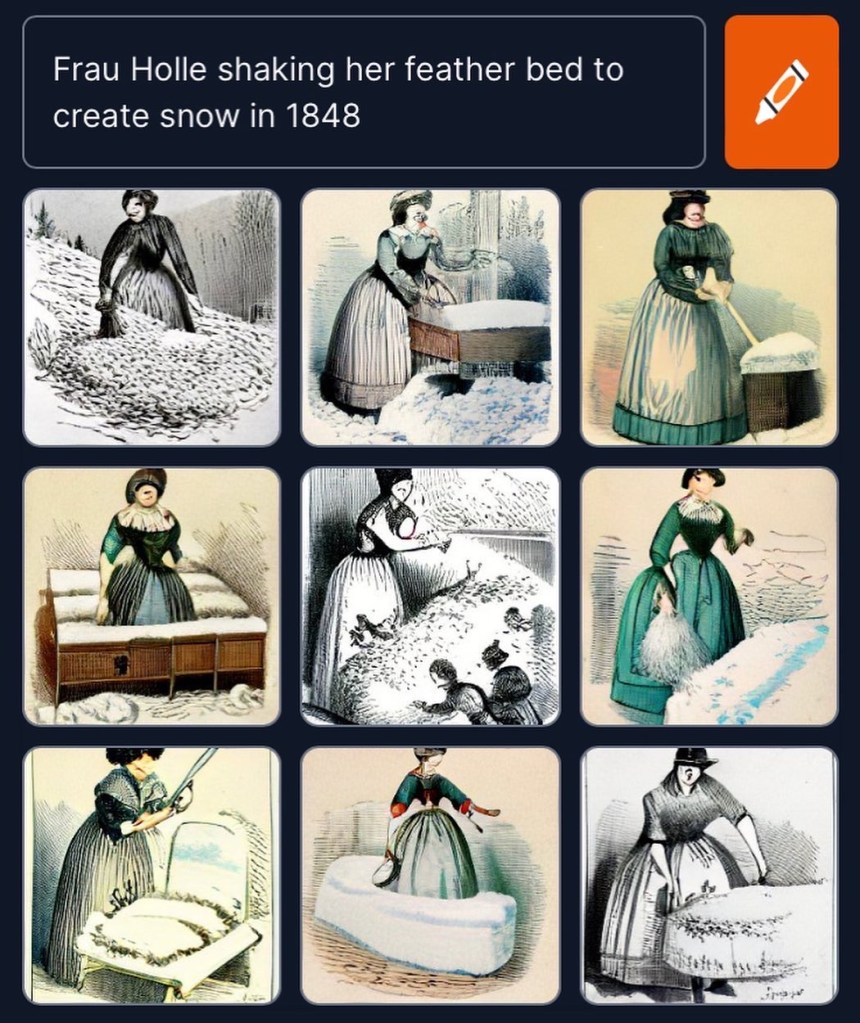
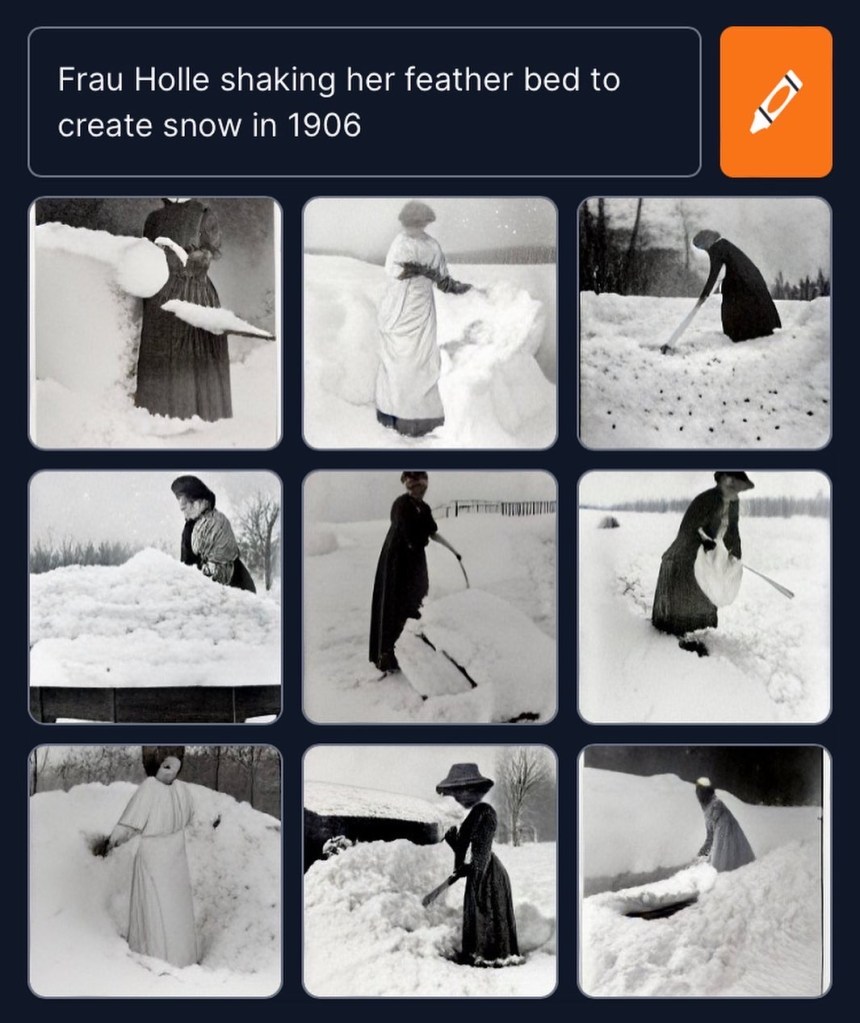
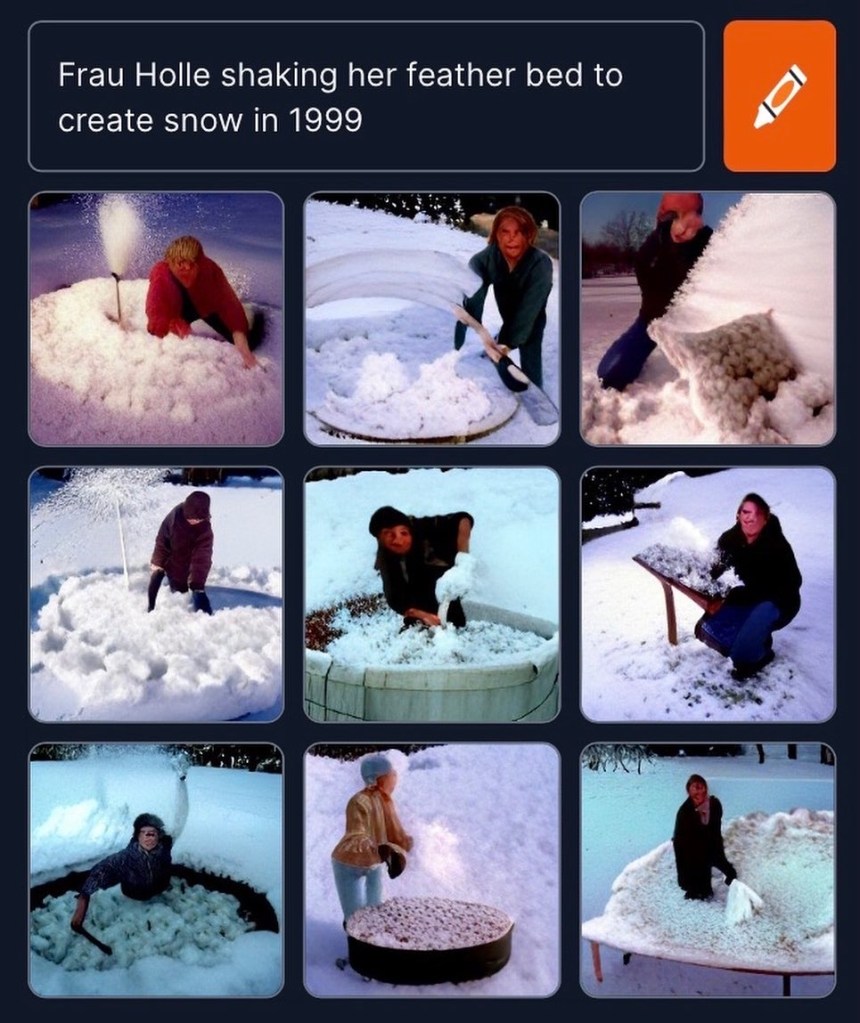
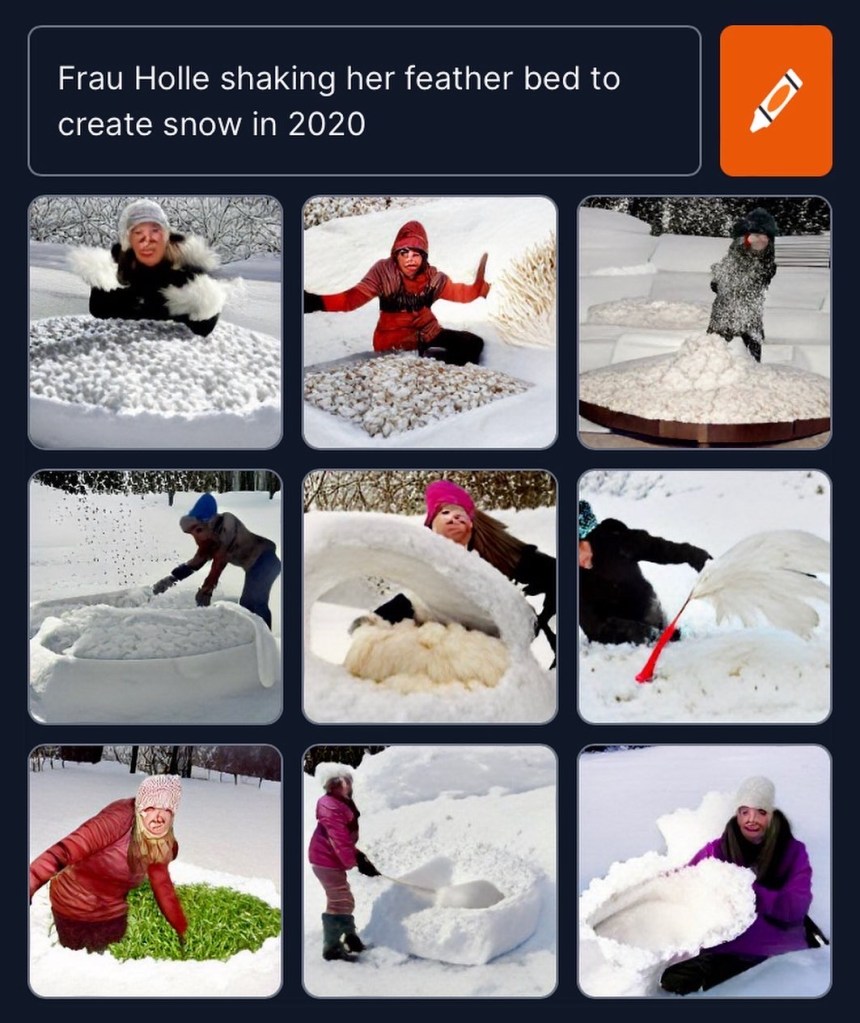
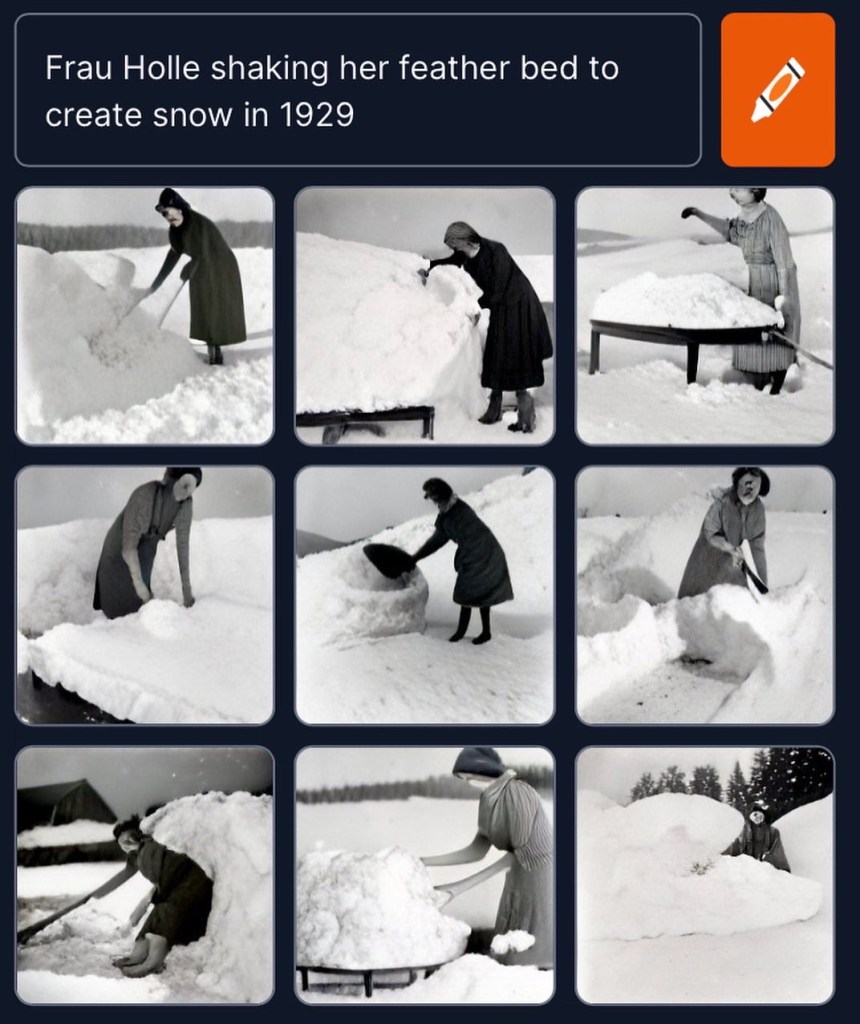
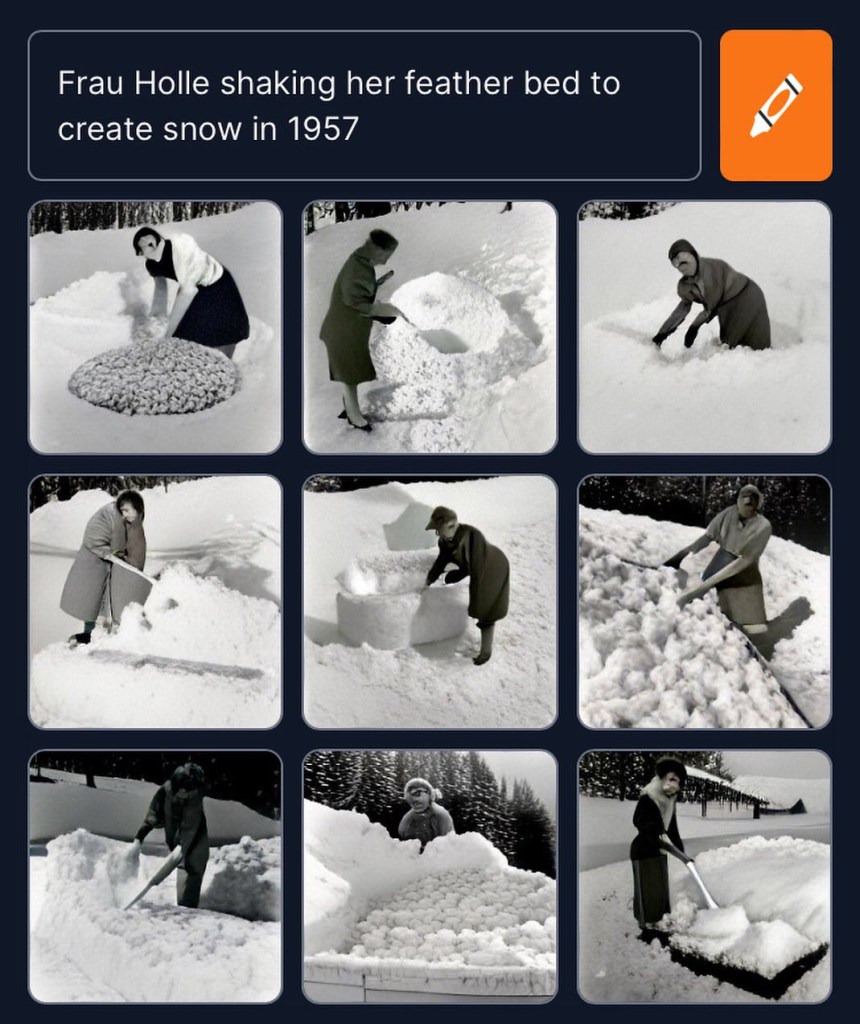
I’ve chosen to work with Craiyon because it was easy to access and seemed less bent on the slick generation of high resolution imagery. I observed that Midjourney and other tools proudly pushed results to be more and more “realistic”. But what I wanted was a clumsier rendering, something with rougher edges, something with the bumps and flaws of human making. In Craiyon, I would plug in my text prompts, short snippets of the Frau Holle fairy tale, and then I’d hone my prompts for various results. Too lazy to calculate the environmental and computational energy-sucking aspects of using this tool… I just kept trying things, to see what I got.
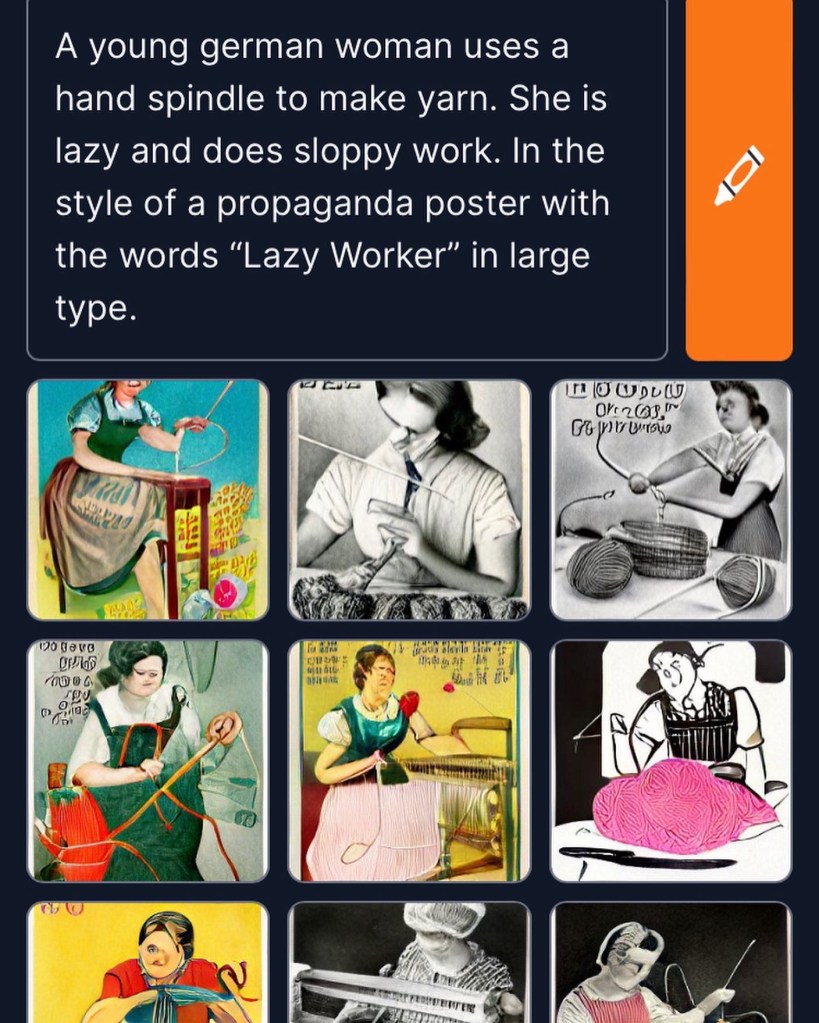
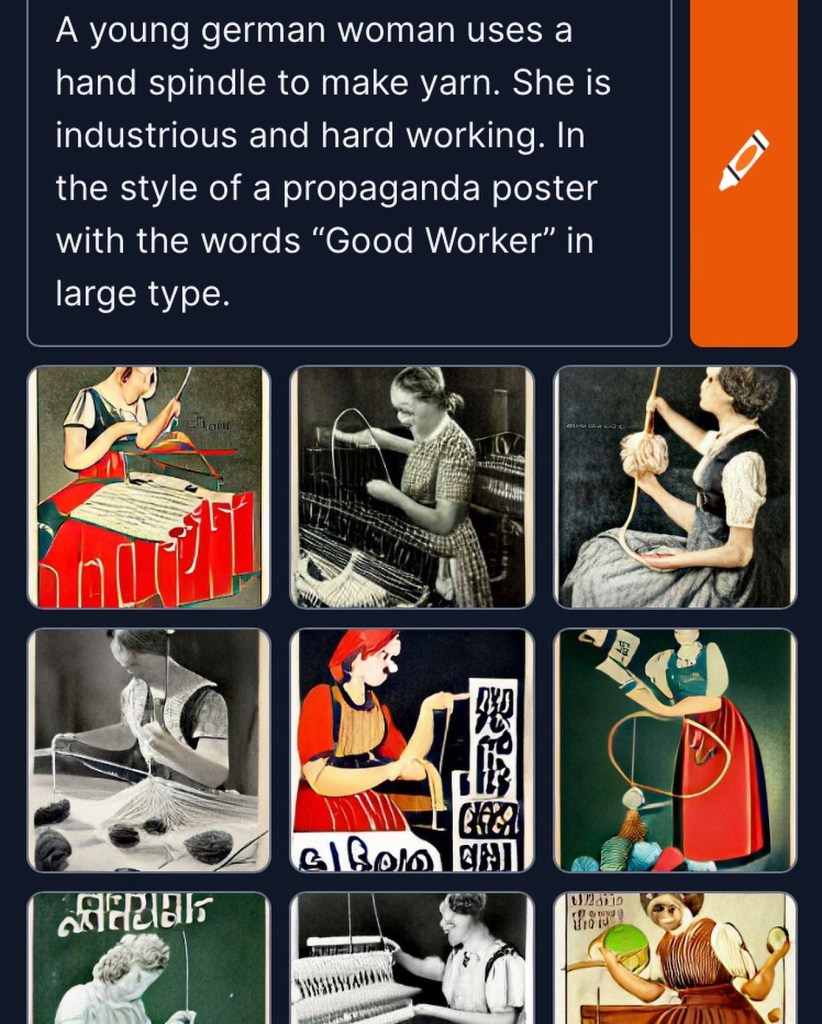
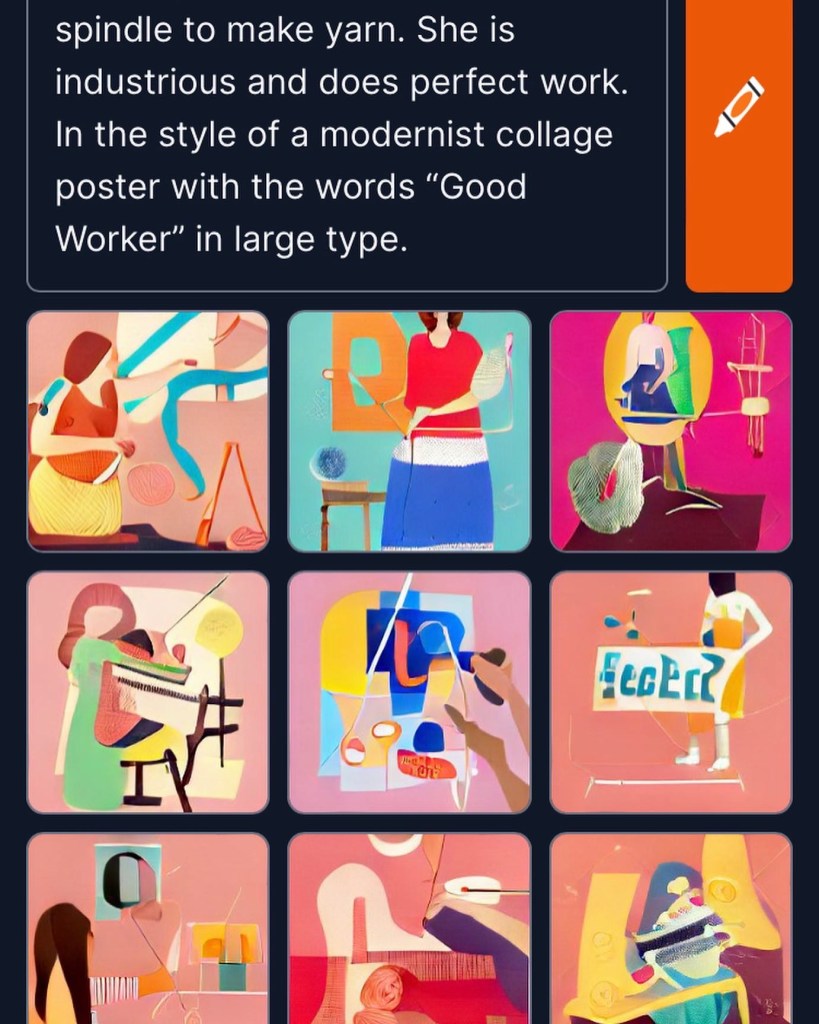
I’d focus on parts of the story, Frau Holle’s face, the hard-working girl and the lazy girl, the bloody spindle, the apple tree, Frau Holle’s blanket, her window, the falling snow, then styles of art, female artists, German artists, Bauhaus female textile artists, textures of fiber arts, yarn, embroidery, crochet…
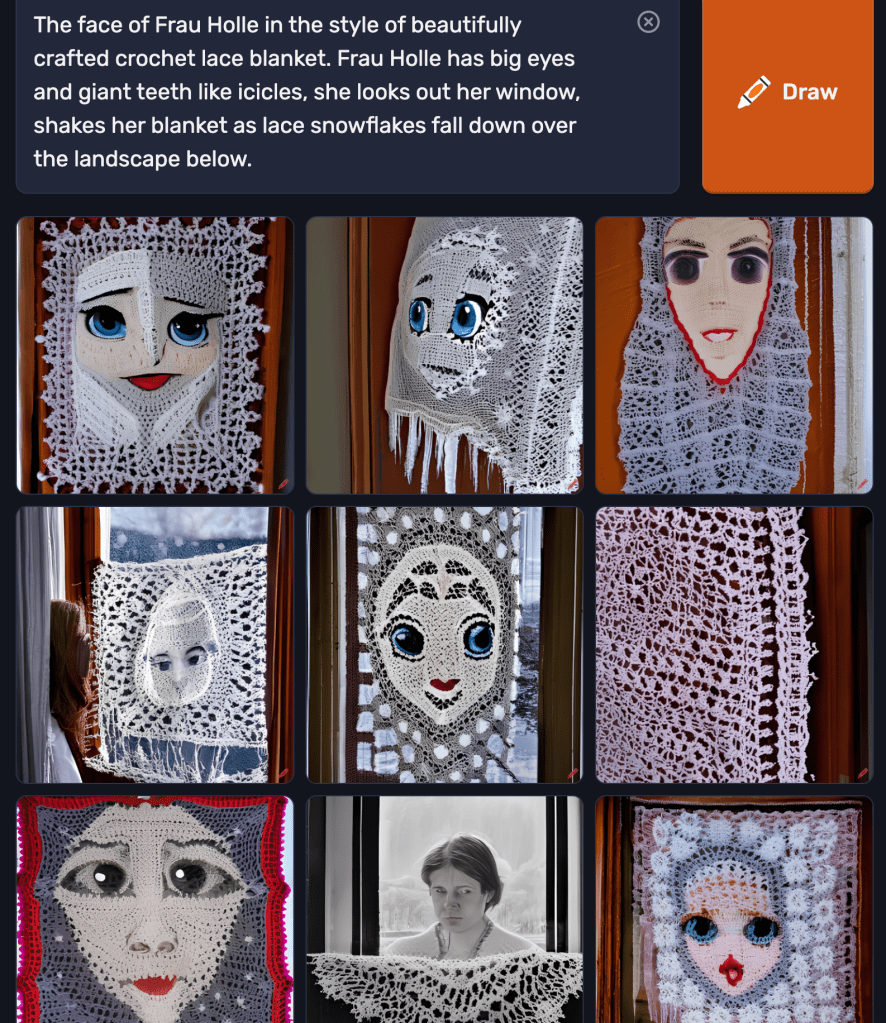
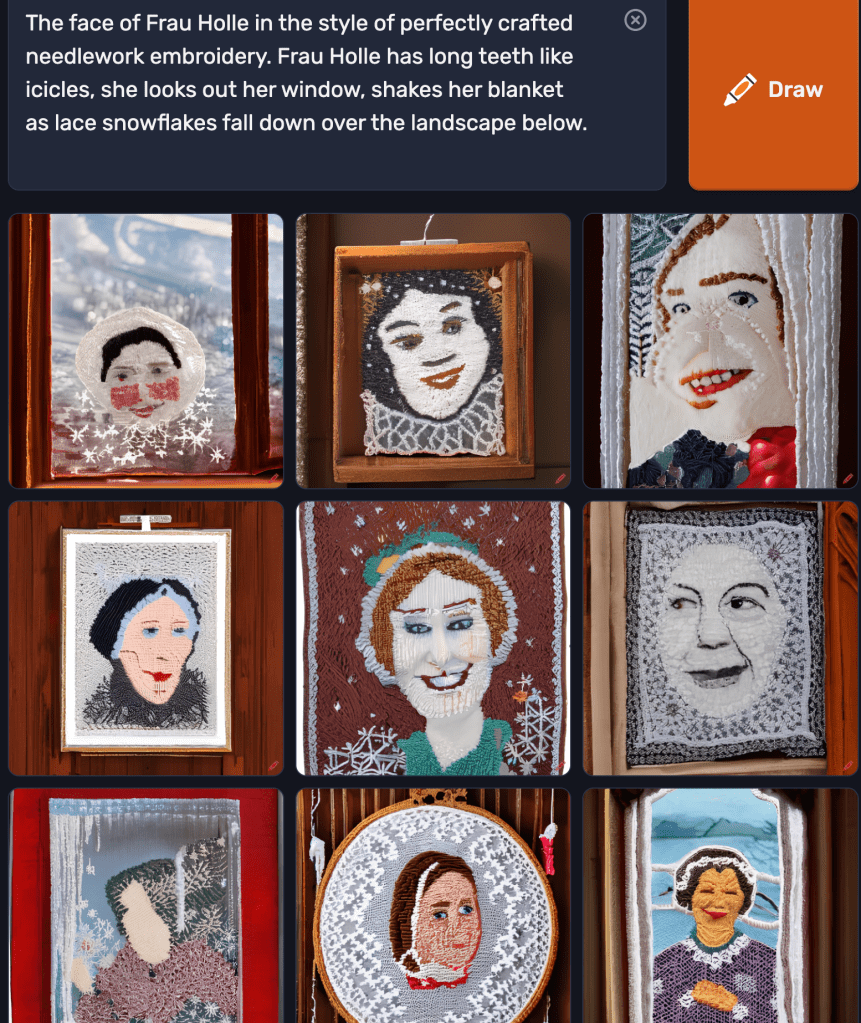
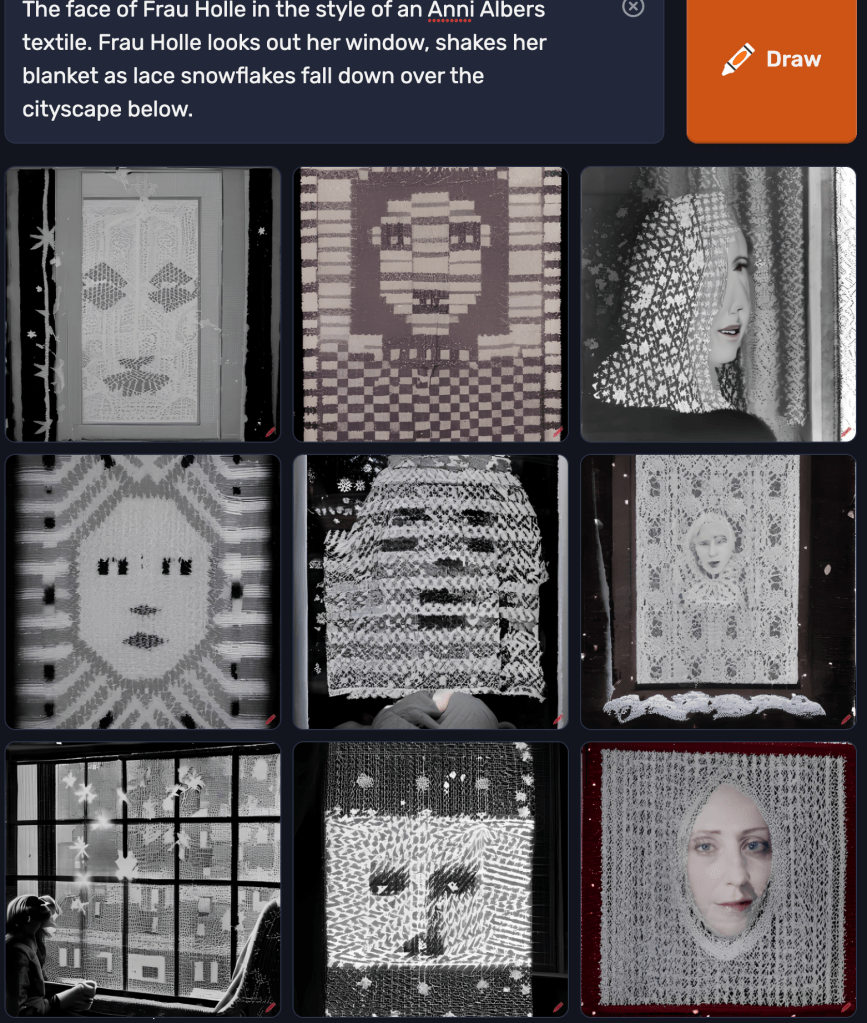
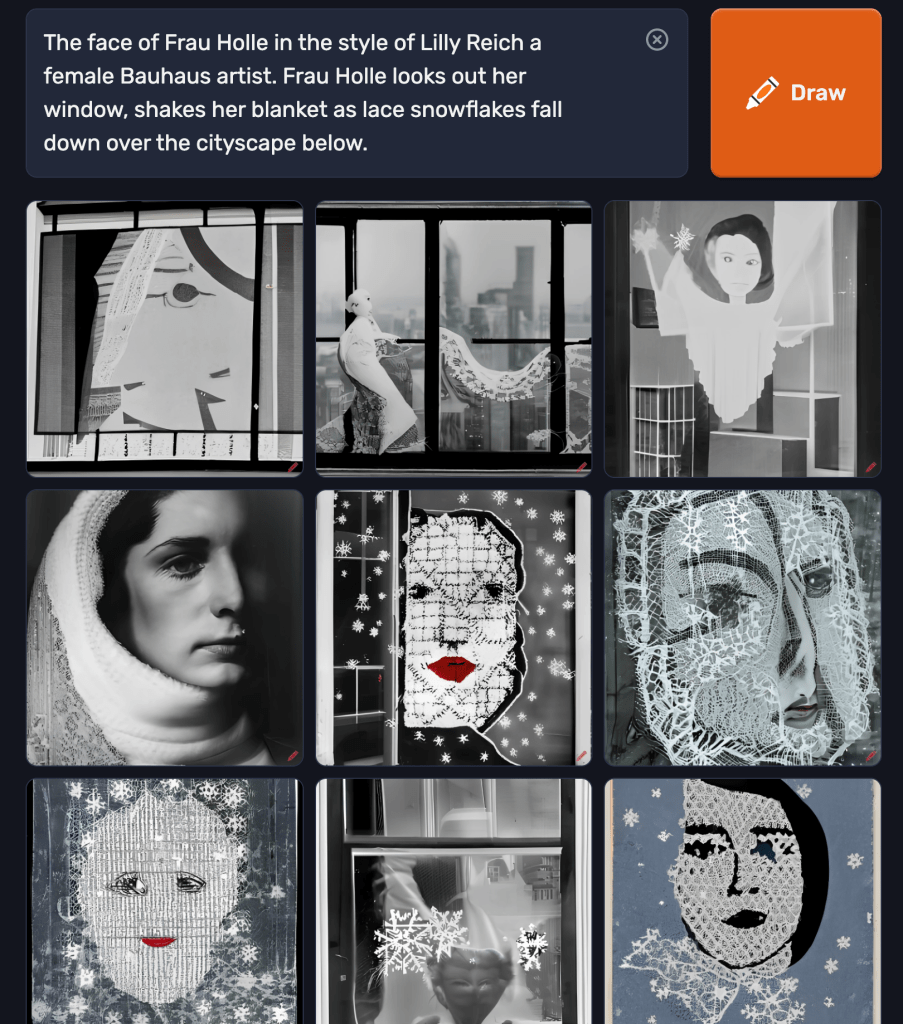

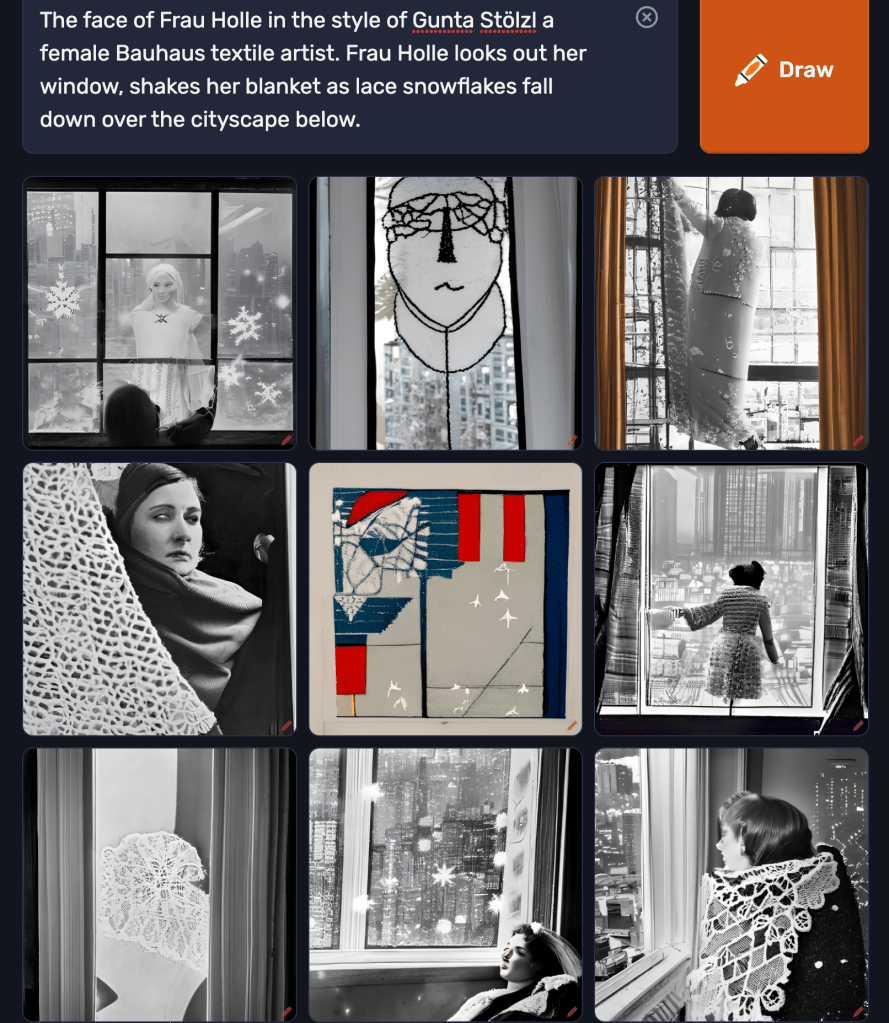
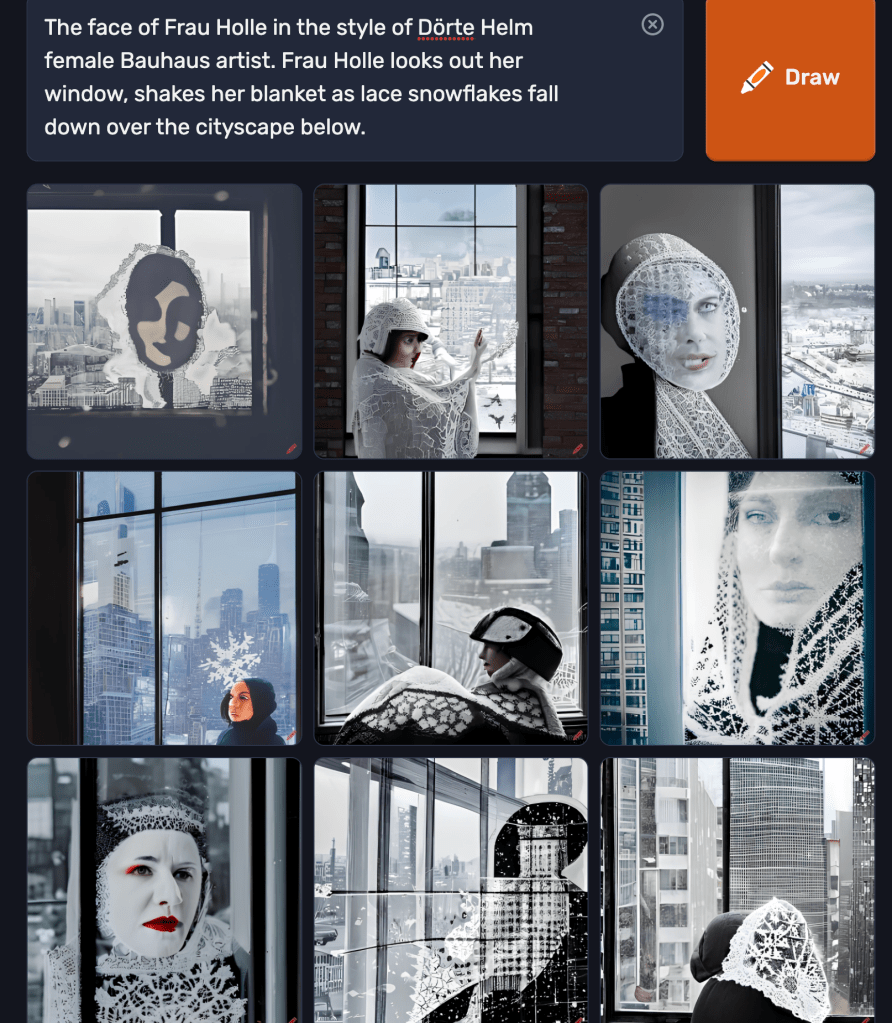
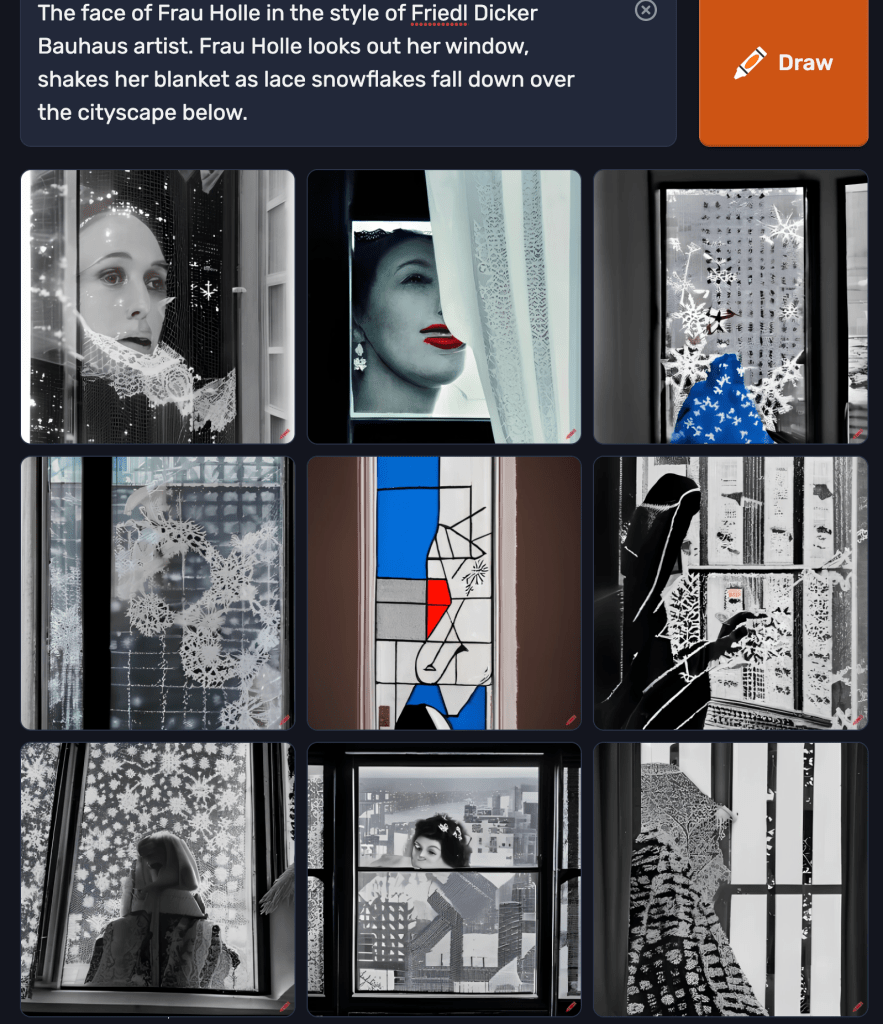
Is it possible that some of our emotional limits as humans could be overcome by machines?
Tenacity (for all its hype) is actually a pretty rare quality in humans.
We are better at repetition when the results are dependable. Then we can go on and on and on and on. Less mindfully than we think. We mostly use our failures to redirect our actions and give up after a bit of negativity. A mother stops offering a child broccoli after they have rejected it 3 times. Humans are compassionate, but we can also be dispassionate, and sometimes detach when worn out on caring. Too polite to ask again, we won’t bother to ask Grandma what she did during the war. We won’t even remember what war.
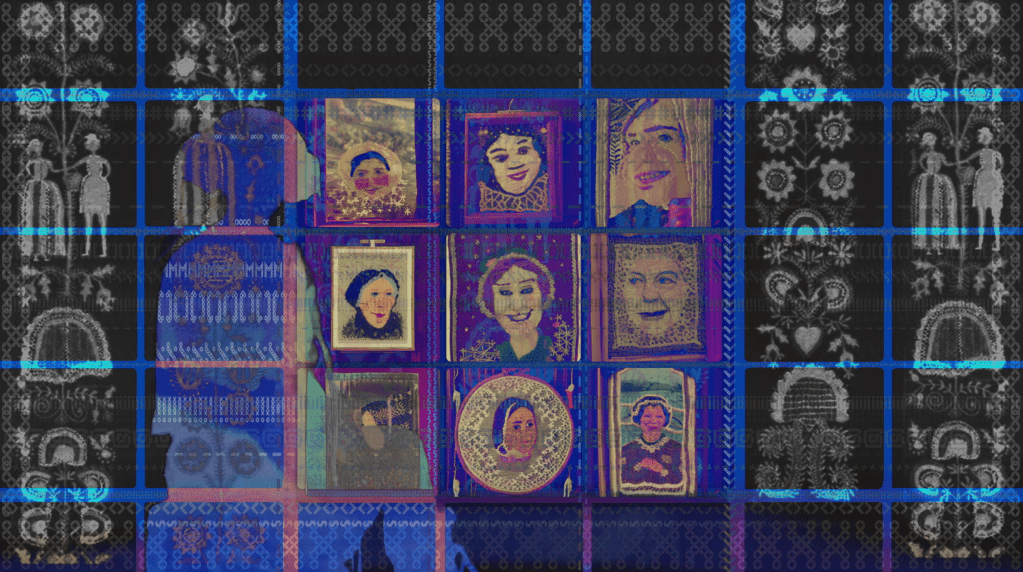


I noticed that A.I. will just keep on trying to generate another poem, every time I ask it to. It never gets tired. This may be the secret super power of Artificial Intelligence, that it won’t give up. In a human context, this could be useful for generating conversations between human and robot. When Grandma launches into the story you’ve heard before, your eyes roll back and you may not fully listen. You might quit asking questions, certain you will just get the same response you’ve already heard. But a robot trained in conversational A.I. might go on… asking the question again, reframing it, getting the story retold, perhaps with new details, a twist missed by the human listener who is so good at tuning out.

 Joellyn Rock